The Cooling Towel: Using the $12 Miracle Correctly
Quick Answer: Wet, wring, snap, wear. Soak the towel, wring it to damp (not dripping), snap it sharply through the air three times to activate the evaporative fabric, and drape it across the back of your neck. Re-snap whenever the chill fades. It works brilliantly in dry heat and only modestly in high humidity.
The cooling towel sits in the sweet spot of summer gear: cheap enough to be an impulse buy, effective enough to feel like witchcraft.
And roughly half the people who own one use it as a regular wet towel, then wonder what the fuss was about.
There’s a technique. It’s four words long.

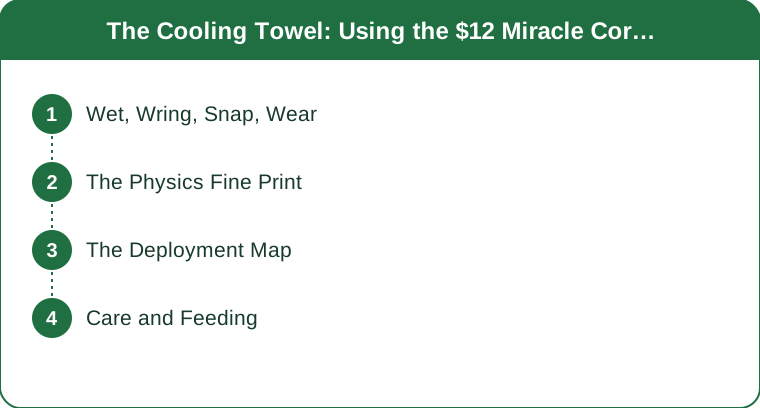
How Do You Actually Use a Cooling Towel?
Wet. Wring. Snap. Wear.
- Soak it in the coldest water you have access to. Tap water is fine; ice water is better but not required.
- Wring it out to damp, not dripping. A soaking towel is heavy and cools less, because the water needs to be in the fabric structure, not running off it.
- Snap it sharply through the air three times. This is the step everyone skips and it’s the one that matters — the snap activates the evaporative fabric and drives air through the weave. It also looks dramatic, which is a legitimate bonus.
- Drape it across the back of your neck, where blood vessels run close to the surface. Wrists and the inside of the elbows are the other high-value spots.
Re-snap whenever the chill fades — usually every 15–30 minutes depending on conditions. No re-wetting needed until the towel actually dries out.
Why Doesn’t It Work as Well in Humid Weather?
Because it cools by evaporation, and evaporation is exactly what humidity suppresses.
In dry heat the water pulls heat off your skin as it converts to vapor, and the effect is genuinely dramatic — a real, measurable drop in skin temperature. In swampy 85% humidity, the air is already close to saturated and evaporation stalls out.
If you live somewhere humid, set expectations at “pleasantly cool” rather than “miraculous,” and pair it with airflow. A fan revives the whole trick — moving air carries the saturated layer away from the fabric and evaporation restarts.
The same logic explains why the towel feels amazing on a breezy hilltop and mediocre in a still, muggy backyard.

Where Is It Genuinely Worth Carrying?
Outdoor workouts. Garden shifts. Sideline parenting at a Saturday tournament. Dog walks in July. Festival survival. Hot-flash management, which is one of the most common uses and rarely mentioned on the packaging.
It lives in the gym bag, folded into its little tube, waiting for its moment like a $12 superhero.
Also worth noting: it’s one of the more useful things to have in a car in summer, particularly if you ever end up stopped in traffic with weak air conditioning.
Myth vs Fact
Myth: The colder the water, the better it works. Fact: Cold water gives a nice initial hit, but the sustained cooling comes from evaporation, not from the water’s starting temperature. Room-temperature water works nearly as well after the first few minutes.
Myth: A wetter towel cools more. Fact: A dripping towel cools less. Excess water runs off instead of evaporating from the fabric, and the towel gets heavy and slaps around.
Myth: Any microfiber cloth does the same thing. Fact: A regular wet cloth does cool a bit, but purpose-made cooling fabric has a structure designed to hold water in suspension and maximize surface area. The difference is real, if not magical.
Myth: You need to re-wet it constantly. Fact: You need to re-snap it. Most people re-wet a towel that was still perfectly damp and just needed air driven through it again.
How Do You Care for It?
- Rinse after sweaty use. Salt and sweat degrade the fabric and, more urgently, smell.
- Hang dry, fully. Don’t fold it away damp.
- Machine wash occasionally on a gentle cycle. Skip fabric softener — it coats the fibers and kills the wicking that makes the towel work.
- Never leave it fermenting in the tube. The towel that smells like regret has been abandoned mid-mission, and that smell does not fully come out.
Treated well, a cooling towel serves for several seasons. Treated badly, it lasts one hot week and a memory.
FAQ
How long does a cooling towel stay cold?
Typically 15–30 minutes per activation in dry conditions, less in humidity. You re-snap rather than re-wet, and a single soaking usually lasts one to two hours of use.
Can I use it on my face?
Yes, and it’s pleasant, but the back of the neck and the wrists are more effective — those are the spots where blood runs closest to the surface, so cooling there has a bigger whole-body effect.
Does it help with hot flashes?
Many people find it does, and it’s one of the more common non-athletic uses. Keep one in the freezer bag or a small cooler and it’s ready with no prep.
Why does mine smell even after washing?
Almost always fabric softener buildup or repeated storage while damp. Wash with a splash of white vinegar and no softener, then dry fully in open air — that clears most cases.
TL;DR:
- The technique is four words: wet, wring, snap, wear
- Wring to damp, not dripping — excess water reduces cooling
- The snap is the step that matters; three sharp snaps activate the fabric
- Wear on the back of the neck, wrists, or inner elbows
- Evaporative cooling: excellent in dry heat, modest in high humidity
- Pair with a fan or breeze in humid climates to restart evaporation
- Re-snap every 15–30 minutes; re-wet only when it’s genuinely dry
- Rinse after use, hang dry, no fabric softener, never store it damp
Twelve dollars, correctly operated, out-cools gadgets ten times the price. Dry air required, drama included.
In serious heat, a towel is comfort, not protection. Dizziness, nausea, confusion, or stopping sweating are heat-illness signs — get to shade and cool water and seek help.
See It in Motion
Seen here: UPF 50+ Short Sleeve Rashguard Swim Shirt — shop it on bubblelime.com
Keep Reading
This article is for general informational and styling purposes only. Fit, sizing, and product availability may vary.