The Complete Guide to When Cooling Gear Actually Makes You Feel Worse
Quick Answer: Cooling gear fails in five specific ways. Evaporative products stop working in high humidity and leave you wet instead of cool. Occlusive cooling garments block your own sweat evaporation, which is a net loss. Cooling something too aggressively triggers vasoconstriction, which reduces heat loss from that area. Cooling before a workout can mask genuine heat strain and let you push further than is safe. And gear worn once the weather cools produces clamminess and chill rather than relief. Match the product to the humidity and to the phase of activity, and most of these disappear.
Cooling gear is genuinely useful and it has a real failure rate that nobody discusses, because the marketing only ever describes the ideal case.
The useful skill is knowing which product fails under which conditions - because the same towel that transforms a dry 35-degree day does nothing at all on a humid 28-degree one, and that is not a defect.

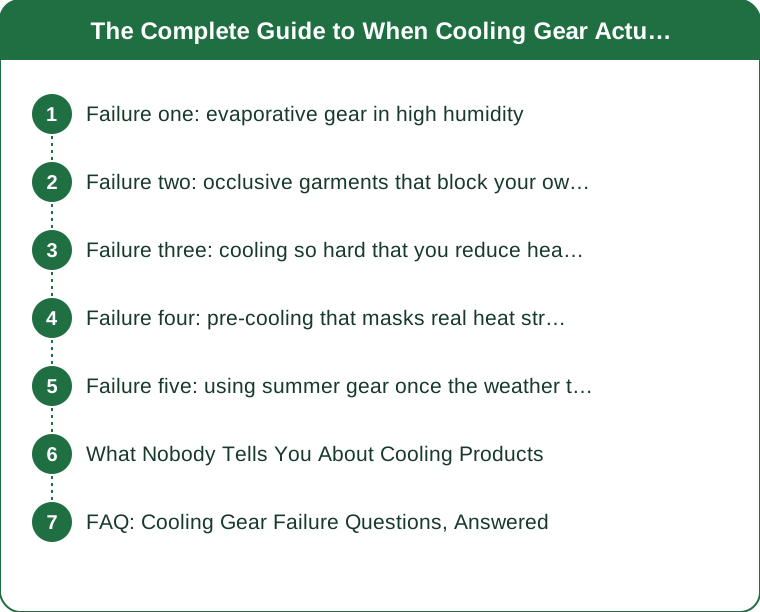
Failure one: evaporative gear in high humidity
This is the most common and most predictable failure, and it accounts for most disappointment with cooling towels.
Evaporative cooling works by turning liquid water into vapour, a process that absorbs a substantial amount of heat energy from the surface it leaves. A damp towel cools your skin because the water in it is evaporating.
That process depends entirely on the surrounding air having capacity to accept more water vapour. In dry air, evaporation is rapid and the cooling effect is strong. As relative humidity rises, the rate falls. At very high humidity, evaporation nearly stops.
What that means practically:
- At 30 percent humidity, an evaporative towel is genuinely effective and will feel cold for a long stretch.
- At 60 percent, noticeably weaker.
- At 85 percent, close to useless as a cooling device - and now you have a wet cloth against your skin adding to the sensation of being clammy.
This is the same reason a dry heat feels more tolerable than a humid one at the same temperature: your own sweat is an evaporative cooling system, and humidity disables it. Anything that cools by evaporation shares that vulnerability.
Worse, there is a second-order effect. A wet towel on your neck in humid conditions covers skin that would otherwise be losing heat through your own sweat evaporation. You may end up marginally worse off than with nothing.
What to use instead in humidity: conductive or phase-change cooling. Ice packs, frozen bottles, phase-change cooling vests, and cold water immersion all work by direct heat transfer and are unaffected by humidity. In a humid climate these are the only cooling methods that reliably do anything.
How to know which you have: if the instructions say wet it, wring it out, and snap it, it is evaporative. If it says freeze it or it contains gel packs or phase-change inserts, it is conductive.
Failure two: occlusive garments that block your own sweat
Your sweat response is a highly effective cooling system. Some cooling products interfere with it.
An adult can lose one to two litres of sweat per hour in hot conditions, and evaporating that sweat removes a very large amount of heat. Nothing you can buy competes with the capacity of your own thermoregulation working properly.
So any garment that covers skin without allowing vapour to escape is a net negative, regardless of what it claims. The failure mode looks like this: a cooling sleeve or vest feels cool for the first ten minutes as its own moisture evaporates, then becomes saturated, then sits as a warm damp layer preventing your skin underneath from doing anything useful.
Products at risk:
- Tight cooling sleeves made of non-breathable fabric. Some are excellent and some are effectively a plastic bag with a cooling claim.
- Cooling vests worn under another layer. The outer layer traps everything.
- Any cooling garment worn on a large percentage of the body surface in conditions where you are sweating heavily.
How to test one: wear it for twenty minutes in the heat. If the skin underneath is wetter than the skin next to it and it feels warm rather than cool, it is blocking evaporation.
The design that works: cooling contact on a small high-value area - neck, wrists, head - with the rest of the skin left free to sweat and ventilate. A cooling neck wrap plus a genuinely breathable shirt outperforms full coverage almost every time.
And the fabric point: any garment sold as cooling should be tested for breathability, not just for how cold it feels in the shop. Cold-to-the-touch finishes on non-breathable fabric are a real category, and they are worse than a plain mesh tee in serious heat.
Failure three: cooling so hard that you reduce heat loss
Aggressive cooling of the skin triggers vasoconstriction, which is your body reducing blood flow to that area - and blood flow is how heat gets out.
Your body dumps heat by sending warm blood to skin capillaries where it can transfer heat to the environment. When skin gets very cold, those vessels constrict to protect core temperature. That is a sensible response to cold and a counterproductive one when you are trying to lose heat.
So an ice pack pressed hard against a large area of skin can genuinely reduce heat dissipation from that area even while it feels intensely cooling. This is a documented consideration in sports cooling practice - the sensation of cooling and the amount of heat actually removed from the body are not the same measurement.
Practical implications:
Cool with cold, not with ice-cold, over large areas. Cool water, cool damp cloths, and cool air are better for sustained heat dumping than direct ice on skin.
Reserve intense cooling for small high-flow areas. The neck, wrists, and palms have relatively high blood flow near the surface and are effective targets for stronger cooling, especially the palms.
Never apply ice directly to skin, both for this reason and to avoid cold injury. Always a layer between.
Rotate rather than sustain. Ten minutes on, ten off, is usually more effective than continuous application at high intensity.
A related error: cooling only the sensation points. Putting something cold on your neck feels dramatic because the area is sensitive, and that sensation can be substantially larger than the actual heat removed. If you are genuinely overheating, sensation is not the metric that matters.

Failure four: pre-cooling that masks real heat strain
Pre-cooling has good evidence behind it for performance in the heat, and it comes with a specific risk that is rarely mentioned.
Pre-cooling - lowering core temperature before exercise using an ice vest, cold drinks, or immersion - genuinely improves endurance performance in hot conditions. It works by increasing the amount of heat you can accumulate before reaching a limiting core temperature.
The risk is that some of your early warning signs for heat strain are perceptual. Feeling hot and uncomfortable is the signal that normally makes you slow down. Pre-cooling reduces that sensation while you continue to accumulate heat, and there are documented concerns that aggressive cooling can allow athletes to push deeper into heat strain before noticing.
This matters most for:
- Recreational exercisers in hot weather without the monitoring an athlete would have.
- Anyone using cooling gear to train through conditions they would otherwise skip. This is the genuinely risky pattern - the gear becomes permission rather than protection.
- People who are not heat acclimatised. Acclimatisation takes one to two weeks of consistent exposure and does far more for heat tolerance than any product.
How to use pre-cooling sensibly:
- Treat it as a performance aid in conditions you would train in anyway, not as an enabler for conditions you would not.
- Watch objective signals rather than only how you feel: heart rate higher than usual for the pace, output dropping, confusion, nausea, or stopping sweating.
- Know the emergency signs. Heat exhaustion - heavy sweating, weakness, nausea, headache, cool clammy skin - needs immediate cooling and rest. Heat stroke - hot skin, confusion, loss of coordination, often no sweating, core temperature very high - is a medical emergency requiring immediate cooling and emergency services.
This is general information, not medical advice. Heat illness can escalate quickly and is potentially fatal. If you suspect heat stroke, call emergency services immediately.
Failure five: using summer gear once the weather turns
The seasonal failure, and it arrives right about now.
As late summer moves into autumn, the same products that helped in August start producing the opposite experience:
Clamminess. In lower ambient temperatures your sweat rate drops, and a cooling garment designed to work with heavy sweating now leaves you damp without the corresponding heat load. Damp plus cool air is how you end up chilled after a workout.
Post-exercise chill. This is the big one. Getting cold after training in cool weather is genuinely unpleasant and it happens fast - the moment you stop producing heat, a wet layer against your skin drops your temperature quickly.
Over-cooling small areas. A cooling neck wrap in 30-degree heat is a relief. The same wrap at 18 degrees produces a cold neck and a stiff upper back.
When to actually retire it:
- Consistently below about 24 degrees Celsius and moderate humidity: most evaporative gear stops being useful.
- Below about 18 degrees: actively counterproductive for most people.
- Indoor training in a heated space is the exception, and heated indoor gyms in winter are a genuine use case that runs all year.
What replaces it: the same problem in autumn is solved by moisture management rather than cooling. A technical base layer that moves sweat away from the skin, and a dry layer to change into afterwards, addresses the actual issue - which is now wetness rather than heat.
And store it properly, since it will be back. Evaporative towels need to be fully dried before storage or they develop mildew and permanent odour. Gel and phase-change packs should be stored where they will not be punctured. Cooling gear stored damp in a gym bag over winter is a product you will be replacing in June.
What Nobody Tells You About Cooling Products
Most of the perceived effect is sensation rather than heat transfer, and the two are genuinely different things.
Menthol-containing cooling products are the clearest example. Menthol activates cold receptors in the skin and produces a strong sensation of cooling without removing any heat at all. Research on menthol has found it improves perceived comfort and sometimes performance through that perception - while having essentially no effect on core temperature.
That is not fraud, and it is worth knowing which one you bought. If your goal is comfort on a hot run, a sensation-based product may be exactly right. If your goal is managing genuine heat strain, it is doing nothing measurable.
The ranking by actual heat removed:
- Cold water immersion. Nothing else comes close.
- Ice packs on high-flow areas, and cold drinks. Internal cooling from cold fluid is genuinely significant and consistently underrated.
- Phase-change cooling vests. Real and modest, and they work in humidity.
- Evaporative products in dry conditions. Real, and entirely dependent on the weather.
- Evaporative products in humidity, and menthol. Sensation, not heat transfer.
The most effective interventions are mostly free. Shade, timing your session away from peak heat, cold drinks, wet skin and moving air, heat acclimatisation over two weeks, and a lighter session on a bad day all outperform any purchase. Cooling gear is a supplement to those, not a substitute.
And the honest assessment: for the majority of recreational training in temperate climates, a frozen water bottle and a change of shirt cover most of what an expensive cooling system does. The products earn their place in genuinely extreme conditions, for people who work outdoors in heat, and for those managing hot flushes or heat sensitivity - which are real applications where the gear is worth every penny.
FAQ: Cooling Gear Failure Questions, Answered
How do I know if my cooling towel is evaporative or conductive?
If you wet it, wring it, and snap it, it is evaporative and it depends on dry air. If you freeze it, or it contains gel or a phase-change insert, it is conductive and works regardless of humidity. Most cheap cooling towels are evaporative.
Why does my cooling vest feel warm after twenty minutes?
Either its cooling capacity is exhausted - phase-change packs have a defined duration, often 90 to 180 minutes - or it is blocking your own sweat evaporation. If the skin underneath is soaked and warm, it is the second, and that vest is a net negative in those conditions.
Can cooling gear actually be dangerous?
Indirectly, in two ways: ice applied directly to skin can cause cold injury, and cooling that reduces your perception of heat strain can let you push further than is safe. The gear itself is not dangerous; using it as permission to train in conditions you would otherwise avoid is the risk.
Is a frozen water bottle as good as a proper cooling product?
For many recreational purposes, close. It provides conductive cooling that works in humidity, it can be applied to high-flow areas, and drinking it as it melts gives you internal cooling, which is one of the more effective routes. It is a genuinely good baseline.
When should I stop using cooling gear for the season?
Roughly when daytime training temperatures settle below about 24 degrees Celsius. Below 18 it usually makes things worse. Keep one item for heated indoor gyms in winter and store the rest fully dry.
TL;DR:
- Evaporative gear fails in humidity - it needs dry air to work, and above about 60 percent humidity it mostly just makes you wet.
- Occlusive garments block your own sweat, which is a far more powerful cooling system than anything you can buy.
- Ice on large areas triggers vasoconstriction and can reduce actual heat loss. Cool with cold, not ice-cold, and target neck, wrists, and palms.
- Pre-cooling can mask heat strain. Use it in conditions you would train in anyway, not as permission for conditions you would not.
- Retire it below about 24 degrees - past that it produces clamminess and post-exercise chill instead of relief.
- Much of the effect of menthol products is sensation, not heat transfer. Useful for comfort, not for genuine heat strain.
- Shade, timing, cold drinks, and two weeks of acclimatisation beat every product on this list.
Cooling gear is genuinely valuable in the narrow conditions it was designed for. The disappointment almost always comes from using an evaporative product in humid air, or from expecting a sensation to be a measurement.
See It in Motion
Seen here: Racerback Tank Top - White — shop similar styles on bubblelime.com
Keep Reading
This article is for general informational and styling purposes only. Fit, sizing, and product availability may vary.