The Complete Guide to Cooling Gear That Earns Its Place in Autumn
Quick Answer: Cooling gear works by moving moisture and increasing evaporation. In cool weather that same mechanism becomes a chilling problem — but three categories still earn their place: moisture-moving base layers, ventilated outer pieces, and anything managing sweat you generate indoors. Everything phase-change or evaporative should be stored.
The drawer full of cooling gear you relied on all summer is now a liability for most sessions and genuinely useful for a few. Sorting which is which is worth twenty minutes.

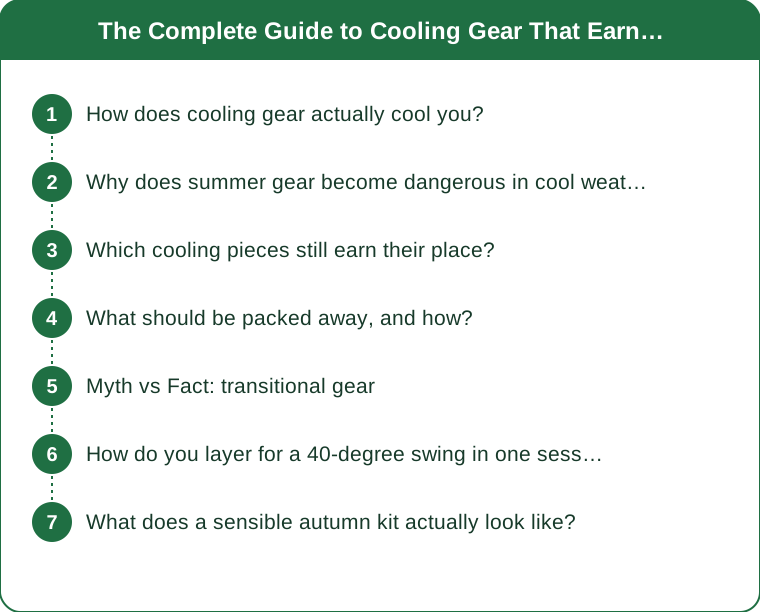
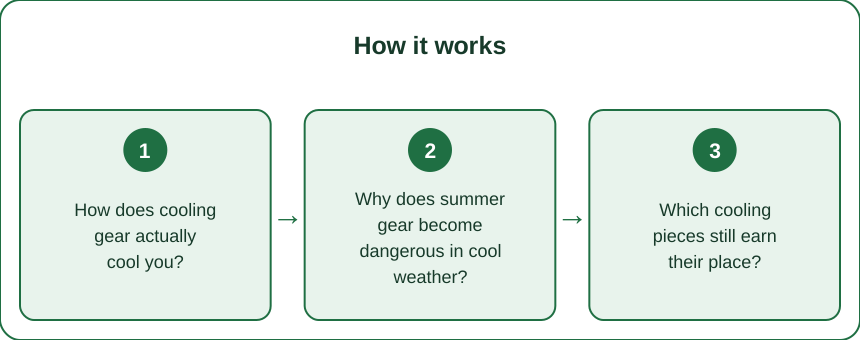
How does cooling gear actually cool you?
There are three distinct mechanisms and they behave completely differently as the season turns.
Evaporative cooling. The dominant one. Sweat absorbs heat from your skin as it changes to vapour — roughly 580 calories per gram of water evaporated. Cooling towels, evaporative vests, and mesh fabrics all work by maximising the surface area and airflow available for that phase change. This mechanism scales with how dry and moving the air is, which is why it underperforms in humidity and overperforms in a breeze.
Conductive cooling. Direct heat transfer to something colder — ice packs, phase-change vests with material that melts at a set temperature, chilled fabrics. Independent of humidity, limited by capacity. Once the material has absorbed its heat, it is done.
Moisture transport. Not cooling in itself, but wicking sweat away from skin so evaporation can happen at the fabric surface instead of against you. This is the one that stays useful year-round.
That third mechanism is the whole answer to the autumn question. Evaporative and conductive gear is designed to remove heat you no longer need to lose. Moisture transport keeps working, because you still sweat in October — you just cannot afford to stay wet.
Why does summer gear become dangerous in cool weather?
Because the same physics that helped in August works against you in October, and it does so at exactly the wrong moment.
During a hard session in cool air, you generate heat and sweat normally. A high-evaporation mesh top does its job efficiently. Then you stop — you finish the run, you walk to the car, you stand around after the session — and heat production drops by a large factor within a couple of minutes while the wet fabric keeps evaporating at the same rate.
That is the post-exercise chill, and it is not merely uncomfortable. Wet fabric in moving air can strip heat far faster than dry fabric, and the effect scales with wind. A cotton or highly evaporative top that felt perfect at mile three can leave you genuinely cold within ten minutes of stopping.
The risk is modest for a short walk to a warm car. It becomes real on a long cool-down, a group session where you stand around, a trail where you are far from shelter, or a morning where the temperature is still dropping.
The design principle for autumn is different from summer. In summer you optimise for maximum heat loss during the session. In autumn you optimise for moving moisture off skin while retaining enough insulation to survive the stop. Those are different garments.
Which cooling pieces still earn their place?
Three categories genuinely survive the transition, and it is worth being specific about why.
Technical base layers with strong moisture transport. A merino or good synthetic base moves sweat off skin and continues to insulate when damp. Merino in particular retains a meaningful proportion of its insulating value wet, which is exactly the property that matters in autumn. This is the single most useful piece to keep in rotation, and it is often filed mentally under summer gear because it is thin.
Ventilated outer layers with closable venting. A jacket or top with pit zips, back vents, or a mesh panel you can cover gives you adjustable heat loss. Open on the climb, closed at the top. Adjustability is the entire value of this category in a season where you might be too hot and too cold within the same hour.
Anything for indoor training. Gym and studio temperatures do not follow the season closely. A mesh top that is wrong for an outdoor run in 50°F is still right for a heated studio in October. Do not pack these away just because the outdoor season changed.
Neck gaiters and buffs, worth a mention, flip roles entirely — a summer cooling buff soaked in water becomes an autumn neck warmer worn dry. Same object, opposite job.

What should be packed away, and how?
Pack away: phase-change cooling vests, ice-pack accessories, chemical cooling towels, and anything whose only function is evaporative cooling with no insulating value — the very open mesh singlets and shorts that were perfect in July.
Storage matters more than people assume, because most of the failures in this category are storage failures rather than wear failures.
Wash everything before it goes away. Salt from sweat is hygroscopic — it draws in moisture — and it degrades elastane over time. A garment stored dirty for six months comes out with less stretch and a persistent odour that washing no longer fixes.
Store dry, cool, and out of light. UV degrades elastane and nylon. A sealed box in a wardrobe beats a shelf near a window.
Do not compress or fold hard. Permanent creases in coated or laminated fabrics can become failure points. Loose-rolled or hung is better than tightly folded.
Cooling towels need to be fully dry. Stored damp they grow mould in weeks and are then a bin item.
Phase-change vests should be stored per their instructions — some prefer being kept in their solid state, some do not care. Check once rather than guess.
Write the date on the box. It is a small thing that saves you wondering next May whether you washed them.
Myth vs Fact: transitional gear
Myth: You need a whole separate autumn wardrobe. Fact: You need three things — a moisture-moving base, an adjustable mid, and a wind layer. Most people already own all three and are simply not layering them.
Myth: Cotton is warmer than technical fabric in cool weather. Fact: Dry cotton insulates adequately. Wet cotton is the worst common fabric for cool conditions — it holds many times its weight in water, loses nearly all insulating value, and dries very slowly.
Myth: If you start warm, you have dressed correctly. Fact: The old advice holds — you should be slightly cool for the first five to ten minutes of a session. If you are comfortable standing still at the start, you will overheat and over-sweat, which is the thing that makes you cold later.
Myth: Sweating less means you need less moisture management. Fact: You sweat substantially in cool weather, you simply notice it less because it evaporates faster. The sweat is still there and still soaking your base layer.
Myth: A waterproof shell solves everything. Fact: A fully waterproof shell over a sweating body traps moisture inside. Unless it is actually raining, a wind-resistant and breathable layer manages the transition far better.
How do you layer for a 40-degree swing in one session?
This is the specific autumn problem: 48°F at the start, 68°F by mid-morning, plus wind on exposed ground.
The three-layer structure, with a rule for each:
-
Base — always technical, always thin. Merino or synthetic, next to skin, chosen for moisture transport rather than warmth. This layer never comes off, which is why it must not be the warm one.
-
Mid — the adjustable one. A half-zip, a vest, or a light fleece. This is where the temperature management happens. A half-zip is a genuinely underrated tool: opening a zip four inches dumps a surprising amount of heat without stopping or removing anything.
-
Shell — wind first, water second. Wind-resistant matters more than waterproof for the majority of autumn sessions. It should pack down small enough that carrying it is not a decision you have to weigh.
Extremities do the fine-tuning. A thin hat and light gloves cost almost nothing to carry and remove more heat when taken off than the equivalent bulk anywhere else, because of the blood flow involved. Most experienced cool-weather trainers manage temperature with hat and gloves and leave the torso layers alone.
Practical sequencing: start slightly cool, open the mid layer at ten minutes, remove hat and gloves at twenty, and stop before the base layer is soaked.
What does a sensible autumn kit actually look like?
Here is the concrete version, in the order you would put it on, with what each piece is doing.
Next to skin: one long-sleeve merino or synthetic base, and one short-sleeve version for milder days. Two is enough if you wash regularly. Choose these on fit and moisture transport, not thickness. Fit matters more here than in any other layer, because a base with air gaps against the skin transports moisture poorly, which is why an oversized base performs worse than a slightly snug one.
Mid layer: one half-zip in a light grid fleece or technical knit. If you buy one new item this season, this is it — it does more temperature management per gram than anything else.
Wind layer: one packable wind shell. It should fit in a jacket pocket or a small waist pack. If it does not pack small, you will leave it behind, and then it will be the day you needed it.
Legs: one pair of mid-weight tights and your existing shorts. Full tights are usually unnecessary above about 50°F if you are moving hard.
Extremities: a thin beanie and light gloves, both of which live permanently in the wind shell pocket so you never have to remember them.
Kept from summer: all technical base layers, ventilated outer pieces, and everything you use indoors.
Stored: phase-change vests, cooling towels, ice accessories, very open mesh pieces.
A word on socks and shoes, which almost every gear list forgets. Wet feet in cool weather are miserable and slow to recover, and summer running socks are often very thin mesh across the top. One pair of merino-blend socks changes autumn training more than most people expect. Shoes with heavy mesh uppers drain well in summer and soak instantly on dewy morning grass, so if you have a second pair with a denser upper, this is the season to rotate them forward.
Reflectivity becomes relevant again. Sunrise is walking later by a couple of minutes each day, and the morning session that was in full daylight in July is in half-light by October. Check that at least one piece in your rotation has real reflective detail rather than a printed logo.
That is a complete system, and for most people it is four purchases at most, because the base layers and shorts already exist. The gear question in autumn is much less about acquiring and much more about sorting what you have into keep, adapt, and store.
TL;DR:
- Cooling gear works by evaporation, conduction, or moisture transport — only the third stays useful as the air cools.
- Wet high-evaporation fabric in cool moving air causes post-exercise chill, which is the real autumn hazard.
- Keep technical base layers, ventilated outer pieces with closable vents, and everything you use indoors.
- Store phase-change vests, cooling towels, and very open mesh — washed, fully dry, loosely packed, out of light.
- Layer as base, adjustable mid, wind shell, and fine-tune with a hat and gloves rather than the torso.
The practical move this week is the twenty-minute sort: three piles for keep, adapt, and store, then wash everything in the store pile before it goes in a box. It costs one evening and it means next spring you open a box of gear that still has its stretch, rather than a box of stiff, salt-crusted disappointments.
See It in Motion
Seen here: Racerback Tank Top - White — shop similar styles on bubblelime.com
Keep Reading
This article is for general informational and styling purposes only. Fit, sizing, and product availability may vary.