The Complete Guide to Storing Cooling Gear for the Off-Season
Quick Answer: Cooling towels, vests, and gel packs fail in storage from three causes: stored damp, stored compressed, and stored warm. Wash everything, dry it completely, store loosely in a breathable container in a cool dark place, and keep gel and phase-change products in the conditions their manufacturer specifies. Doing this takes an afternoon and roughly doubles how long the kit lasts.
You put the cooling towel in the box at the end of last summer.
You opened it in June and it smelled like a pond and had lost most of its function.
It did not wear out in use. It was killed in the cupboard, and the whole thing was preventable.

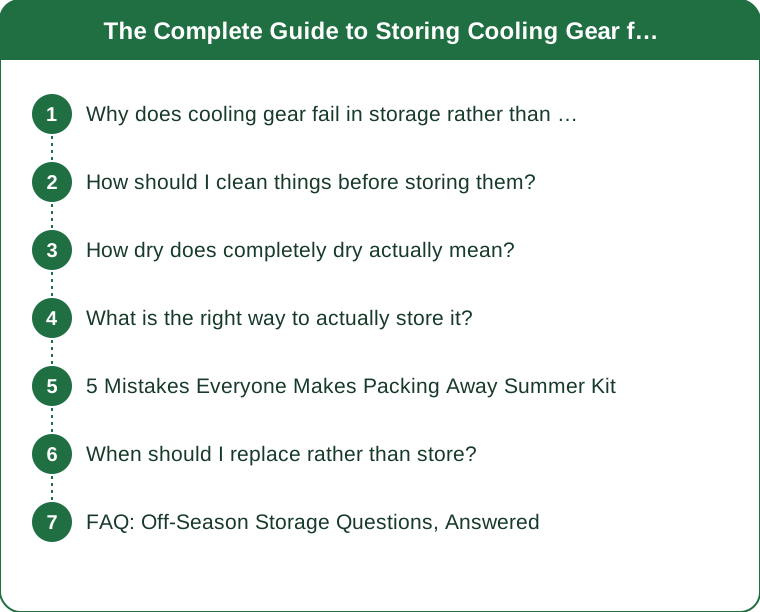
Why does cooling gear fail in storage rather than in use?
Because storage combines the three conditions that damage these products, and it does so for seven uninterrupted months.
Residual moisture. Cooling products are designed to hold water — that is the entire mechanism. Evaporative towels and vests retain moisture deep in their structure long after the surface feels dry. Sealed away damp, they become an ideal environment for mould and bacteria. This is the single most common failure, and it is why the towel smells.
Compression. Most of these products work through structure — an open weave, a hollow fibre, a foam matrix, a channel network. Crushed under other items for months, that structure takes a permanent set. A cooling vest folded hard along the same crease for seven months develops a fold that never fully recovers, and the material’s ability to hold and release water is reduced at that line.
Temperature. Attics, garages, and lofts swing enormously — well above 100 degrees in summer and below freezing in winter. Polymers, gels, and elastic components all degrade faster at temperature extremes, and phase-change materials in particular can be permanently damaged by repeated cycling outside their intended range.
Residual body oils and sunscreen. These accumulate in fabric all summer. Left in place over winter they oxidise, which produces both permanent odour and degradation of the fibre. Sunscreen is particularly aggressive toward elastane.
Address those four and almost everything survives the off-season intact.
How should I clean things before storing them?
Thoroughly, and specifically rather than generically, because the product types need different treatment.
Evaporative cooling towels. These are usually PVA or a synthetic microfibre. Wash in cool water with a small amount of mild detergent, then rinse very thoroughly — detergent residue is what clogs the pores and reduces evaporative performance next season. No fabric softener under any circumstances; it coats the fibre and destroys the mechanism entirely. Some manufacturers recommend a dilute white vinegar rinse to remove mineral buildup from hard water, which is worth doing if your water is hard.
Cooling vests with removable inserts. Take the inserts out first. Wash the shell according to its label, and treat the inserts separately — they are usually not machine washable.
Cooling apparel with treated fabrics. Many use a mineral or polymer finish applied to the fabric. Wash cool, avoid softener, and skip any high-heat drying, which can degrade the finish. These treatments are more durable than they used to be but still finite.
Neck wraps and bandanas with polymer crystals. These need to be fully dried out, which takes considerably longer than it appears — the crystals hold water deep inside. Allow several days of air drying before storage, and check the weight rather than the surface feel.
Gel packs and phase-change packs. Wipe the outside clean, inspect for any leaks or weak seams, and follow the manufacturer’s storage instruction, which varies substantially between products.
Whatever the type, the drying step is more important than the washing step. Almost every storage failure traces back to something that was not completely dry.
How dry does completely dry actually mean?
Considerably drier than it feels, and this is the step people rush.
A cooling towel that feels dry to the touch on the surface can hold a meaningful amount of water in its interior structure. That is by design — it is what makes it work for hours in the sun. It also means surface dryness is not a reliable test.
Practical ways to confirm:
Weigh it. The most reliable method. Note the weight when new and dry, and compare before storage. If it is heavier, it is still holding water.
Give it several days in moving air. Not folded, not in a pile — spread out or hung, somewhere with air movement. Two to four days is realistic for a thick towel or a vest insert.
Avoid direct heat to speed it up. A radiator or hot dryer risks damaging the polymer or the treatment. Time and airflow are what you want.
Check the seams and thick sections. Bindings, edges, and any padded areas dry last and are where mould starts.
Do not store in a sealed plastic bag. Even a small amount of residual moisture in a sealed bag guarantees a problem. Breathable storage — a cotton bag, a cardboard box, a container with the lid loose — allows any remaining moisture to escape.
If you are ever uncertain, err toward more drying time. There is no downside to an extra week, and there is a substantial downside to an extra ounce of water.

What is the right way to actually store it?
Loosely, cool, dark, and dry, in that order of importance.
Store loose or lightly rolled, never tightly folded. Rolling avoids sharp creases. If a product must be folded, refold it along different lines than last year so the same fibres are not repeatedly stressed.
Do not compress under other items. This is what kills vests and structured products. Give them their own space, even if that means a larger box.
Choose a cool location with stable temperature. Inside the house is nearly always better than a garage, loft, or shed. A wardrobe shelf or under-bed box in a heated part of the home is ideal.
Keep it dark. UV degrades polymers and fades treated fabrics, and even indirect window light over seven months adds up.
Use breathable containers. Cardboard boxes, cotton bags, or plastic boxes with the lid not fully sealed. Airtight is the wrong instinct here.
Label the box. Obvious, and consistently skipped. A box labelled with contents and the date it was packed means you actually find the kit next May rather than buying replacements.
Store gel and phase-change products according to their specific instructions. Some want room temperature, some want refrigeration, and some are damaged by freezing. This is the one category where the manufacturer’s instruction genuinely varies and genuinely matters.
5 Mistakes Everyone Makes Packing Away Summer Kit
1. Packing it away on the last hot day. The kit gets used, thrown in a bag, and stored the same week. Almost nothing is fully dry on that timeline. Wash and dry first, store two weeks later.
2. Using vacuum bags. Excellent for bulky bedding, terrible for anything structural. Vacuum compression permanently damages open-cell foams, channelled fabrics, and anything that works through loft or airflow.
3. Storing in the garage or loft. The two worst locations available, and the two most commonly used. Temperature extremes in both are well outside what these materials tolerate well.
4. Skipping the inspection. Storage is the natural moment to check for seam failures, leaking gel packs, and worn elastic. Finding a failed vest in October means you can replace it in an off-season sale rather than at full price in a June heatwave.
5. Storing it all together with the winter kit coming out. The third mistake gets worse when the boxes get mixed — cooling gear stored alongside heavy winter items ends up compressed under them, which undoes the careful drying and loose packing you just did. Separate boxes, separate shelves.
When should I replace rather than store?
Some things are not worth the shelf space, and October is the honest moment to decide.
Replace an evaporative towel that no longer cools well even when properly wetted. These have a finite life as the pore structure clogs with minerals, oils, and detergent residue. Two to three seasons of regular use is typical.
Replace anything with mould you cannot fully remove. Mould in a porous cooling fabric is generally not recoverable, and it is not worth the health question.
Replace gel packs with any sign of leakage or seam bulging. A pack that fails in a bag ruins everything around it, and a bulging seam is a warning.
Replace cooling apparel that has lost its finish. If a treated garment no longer feels cool to the touch when damp, the treatment is gone and washing will not bring it back.
Reconsider anything you did not use. If the cooling vest stayed in the drawer all summer, storing it carefully for seven months to not use it again is a poor use of effort and space. Sell it or pass it on while it still works.
Buy replacements now, not next June. End-of-season is when cooling gear is cheapest by a wide margin, and it is the one category where the pricing gap between October and June is enormous. Making the replacement decision at pack-away time rather than at the first heatwave is worth real money.
This is general information rather than medical advice — anyone using cooling products to manage a medical condition, such as heat intolerance related to MS, should follow the specific guidance from their clinician about equipment maintenance and replacement.
FAQ: Off-Season Storage Questions, Answered
Can I store cooling towels wet in the fridge like I do during summer?
For a few days between uses, yes, that is standard practice. For seven months, absolutely not — a fridge is a cool damp environment and something stored there long-term will spoil.
Do cooling products expire?
Fabric-based ones degrade gradually rather than expiring. Phase-change and gel products often do have a stated lifespan, typically several years, after which the material no longer changes phase reliably.
Should I wash them again before using next summer?
A quick rinse is worthwhile to clear any dust and to rehydrate the fabric, but a full wash is unnecessary if they were cleaned properly before storage. Check for any smell first — that is the test of whether the storage worked.
TL;DR:
- Cooling gear usually fails in storage, not in use, from damp, compression, and temperature extremes
- Wash cool with minimal detergent, no softener, and rinse very thoroughly
- Dry for days rather than hours, and weigh items if you want certainty
- Store loose, in the dark, in a breathable container, inside the heated part of the house
- Never vacuum-bag anything structural, and never use the garage or loft
- Inspect while packing and buy replacements at end-of-season prices rather than in June
An afternoon in October is the difference between opening the box next summer to working kit and opening it to a pond smell. Wash it, dry it properly, and give it enough space to keep its shape.
See It in Motion
Seen here: High Waist 8” Yoga Shorts — shop similar styles on bubblelime.com
Keep Reading
This article is for general informational and styling purposes only. Fit, sizing, and product availability may vary.