Why Your Cooling Gear Stops Working After 20 Minutes - and How to Reset It
Quick Answer: Most cooling gear works by evaporation, not by being cold. A wet towel or sleeve cools you only while water is leaving the fabric, so it fades in roughly 15 to 25 minutes in dry heat and much faster in humidity above 70 percent. The reset is simple: re-wet and wring every 20 minutes, keep the fabric thin, and move air across it. Phase-change vests are the exception - they hold a set temperature for 2 to 3 hours but only if you pre-chill them fully.
Here is the moment everybody knows. Twenty minutes into an August walk, the towel around your neck feels like a warm dishrag, and you are somehow hotter than before you put it on. The gear did not fail. It finished its job and nobody told you.

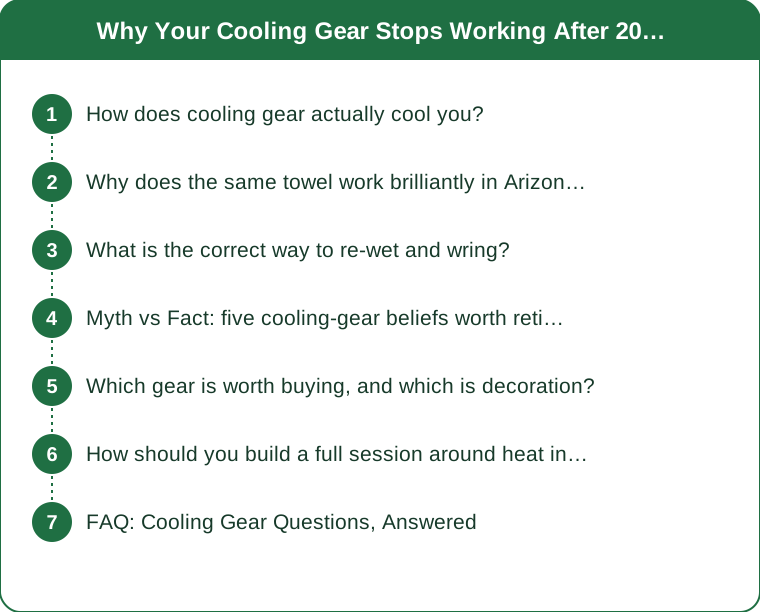
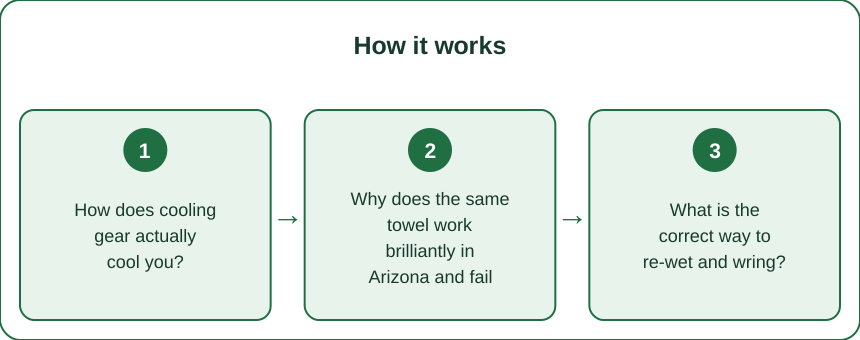
How does cooling gear actually cool you?
There are only four ways your body sheds heat, and gear can only borrow from those four. Conduction moves heat into something cooler that touches your skin - an ice pack, a chilled gel insert. Convection carries heat away in moving air or water. Evaporation takes the biggest share during exercise, because turning liquid water into vapor consumes about 580 calories of heat per gram evaporated. Radiation is what a light-colored, loose layer manages when it blocks sun instead of absorbing it.
Almost every product marketed as cooling gear is an evaporation tool wearing a clever name. The specialty towel, the arm sleeve, the neck gaiter, the hat with the hidden mesh panel - all of them hold water against a large surface area and let it leave slowly.
That matters for one blunt reason. Evaporative gear does not have a battery. It has a fuel tank, and the fuel is water. When the water is gone the item is not merely neutral, it is now an extra insulating layer trapping heat against your skin. The 20-minute cliff people describe is just the tank running dry, and the warm-dishrag feeling afterward is the insulation penalty.
Understanding which mechanism a product uses tells you exactly how to keep it alive. Evaporation gear needs water and airflow. Conduction gear needs a cold start and mass. Nothing you own does both well.
Why does the same towel work brilliantly in Arizona and fail in Florida?
Humidity is the single variable that decides whether evaporative gear is a genius purchase or a wet scarf. Evaporation depends on the vapor pressure gap between the wet fabric and the surrounding air. In dry heat that gap is enormous, so water leaves fast and takes a lot of heat with it. In humid air the surrounding atmosphere is already close to saturated, and there is nowhere for the vapor to go.
Rough field numbers make it concrete. At 95F and 20 percent humidity, a properly wrung towel gives noticeable relief for 20 to 30 minutes. At 88F and 80 percent humidity, that same towel may feel pleasant for 5 minutes because it is cold water, then do essentially nothing.
In high humidity, switch strategy entirely. Stop chasing evaporation and go for conduction instead: an ice-filled bandana, a frozen bottle held at the palms or forearms, a phase-change vest. These move heat by contact and do not care how saturated the air is.
This also explains a frustrating pattern. People buy cooling gear during a dry-heat vacation, love it, bring it home to a humid climate, and conclude the product was a scam. Same product, different physics.
What is the correct way to re-wet and wring?
Most people over-soak and under-wring, which is exactly backward. A dripping towel is heavy, sits in a thick wet slab, and evaporates only from the outer surface. A firmly wrung towel spreads a thin water film across far more fiber area, and thin films evaporate several times faster.
The habit that works looks like this. Soak the item fully, then wring until it stops dripping and feels damp rather than wet. Snap it through the air five or six times - this is not folklore, moving air across a thin film accelerates evaporation and drops the fabric temperature measurably before it touches you. Apply it to a spot with shallow blood flow near the surface: neck, wrists, inner forearms, temples.
Then set a mental timer for 20 minutes. In dry heat you can stretch that to 30. In humidity, cut it to 10 or skip evaporative gear altogether.
One detail nobody mentions: carry a small squeeze bottle with 8 to 10 ounces of plain water reserved for gear, separate from your drinking supply. Reaching for your hydration bottle to re-wet a towel is how people end up rationing their own fluid intake in the exact conditions where they should not.

Myth vs Fact: five cooling-gear beliefs worth retiring
Myth: Colder is always better. Fact: ice directly on skin causes reflexive vasoconstriction, which narrows the vessels carrying heat to the surface. You feel cold locally while shedding heat more slowly overall. Put a thin layer between ice and skin.
Myth: Cooling gear replaces hydration. Fact: it reduces sweat losses modestly at best. In real conditions you still lose roughly 0.5 to 1.5 liters an hour, and skin that feels cool makes thirst cues less obvious - a mild trap.
Myth: Black cooling sleeves are fine because the fabric is technical. Fact: in direct sun a dark sleeve absorbs meaningfully more radiant heat than a light one. Fabric technology does not repeal color physics.
Myth: Wetting your shirt is the poor person’s cooling vest. Fact: this one is actually true, and it is the third surprise for most people. A soaked cotton-blend shirt in dry heat is genuinely competitive with expensive gear for the first 20 minutes.
Myth: You should cool down before you get hot. Fact: pre-cooling is real and well studied, but it works through core temperature, not skin. Ten to fifteen minutes with a cold drink or a chilled vest before you start buys you more than anything you do at minute 30.
Which gear is worth buying, and which is decoration?
Phase-change cooling vests are the only category that holds a stable temperature for hours. The inserts freeze at a set point - commonly 58F or 65F rather than 32F - and stay there while they melt. That set point matters, because a 32F ice vest feels dramatic and triggers the vasoconstriction problem, while a 58F insert sits in the sweet spot. The catch is cost, weight of 2 to 5 pounds, and a required pre-chill of 2 or more hours.
Evaporative towels and sleeves are cheap, light and genuinely effective in dry heat with a re-wet habit. Treat them as consumables that need attention every 20 minutes.
Cooling insoles, cooling headbands and cooling underwear are mostly marketing. Small surface area, poor airflow, minimal water capacity.
Frozen bottles are underrated. Two 16-ounce bottles frozen solid give you conduction at the palms, which have dense arteriovenous anastomoses - vessels that dump heat efficiently. Hold them for 3 to 5 minutes at a time.
If your budget allows one purchase for humid climates, buy the vest. For dry climates, buy three cheap towels and rotate them.
How should you build a full session around heat instead of fighting it?
Gear is the last 15 percent. The first 85 percent is scheduling, pacing and clothing.
Move the session. Between roughly 11am and 4pm in late summer, radiant load from the sun can add the equivalent of 10 to 15 degrees to what the thermometer says. Shifting a workout to 7am or after 6:30pm does more than any product.
Cut intensity for the first 10 to 14 days of a heat wave. Heat acclimatization is real physiology - plasma volume expands, sweat starts earlier and contains less sodium - and it takes about two weeks. Fighting through week one at normal intensity is how people end up with a bad afternoon.
Dress for evaporation: light colors, loose weave, no more coverage than the sun requires. A tight technical layer that traps a humid microclimate against skin defeats the thing you are trying to encourage.
And learn the stop signs. Skin that goes clammy and pale, a headache that arrives suddenly, chills in the heat, or confusion are not push-through symptoms. Stop, get to shade, cool the neck and armpits, and get fluids. This is general information, not medical advice - if symptoms escalate or someone stops making sense, treat it as an emergency.
FAQ: Cooling Gear Questions, Answered
How often should I re-wet a cooling towel?
Every 20 minutes in dry heat, every 10 in humidity, and immediately any time it feels warm rather than cool. Once it stops feeling cool it has become an insulating layer, so re-wet it or take it off.
Do cooling vests actually lower core temperature?
Phase-change vests can slow the rise in core temperature during sustained work, which is the practical benefit. They are better at delaying overheating than at reversing it, so put one on before you are hot rather than after.
Is it bad to put ice directly on my neck?
Brief contact is fine, but sustained direct ice constricts surface vessels and slows overall heat loss, plus it risks skin irritation. A thin cloth barrier and 3 to 5 minute intervals give you the cooling without the downside.
TL;DR:
- Nearly all cooling gear runs on evaporation, so it has a fuel tank of water rather than a battery - expect 15 to 25 minutes per fill in dry heat.
- Humidity above 70 percent essentially disables evaporative gear; switch to conduction with ice, frozen bottles or a phase-change vest.
- Wring until damp, not dripping, snap it through the air, and apply it to the neck, wrists and inner forearms.
- Pre-cooling before you start buys more than anything you do once you are already overheated.
The honest summary is that cooling gear did not let you down at minute 20 - it simply finished a job it was only ever built to do once per soak. Treat the towel like a water bottle that needs refilling and it stops being a disappointment. Treat the schedule and the shade as your primary tools, and the gear becomes what it should have been all along: a small, reliable assist rather than the whole plan.
See It in Motion
Seen here: Yoga Jogger Sweatpants with Pockets — shop it on bubblelime.com
Keep Reading
This article is for general informational and styling purposes only. Fit, sizing, and product availability may vary.