The Complete Guide to Retiring Your Cooling Gear and Switching to Layers
Quick Answer: Cooling gear fails in storage far more often than in use. Cooling towels and vests should be washed without fabric softener, dried completely before storage, and kept dry and loose rather than sealed damp - mildew is the most common cause of a towel that no longer works. As conditions change, the replacement is not a warmer version of the same thing but a layering system that manages moisture rather than removing heat.
The end of the cooling season is the point at which most of this equipment quietly gets ruined, because it goes into a box in the state it came out of a bag.

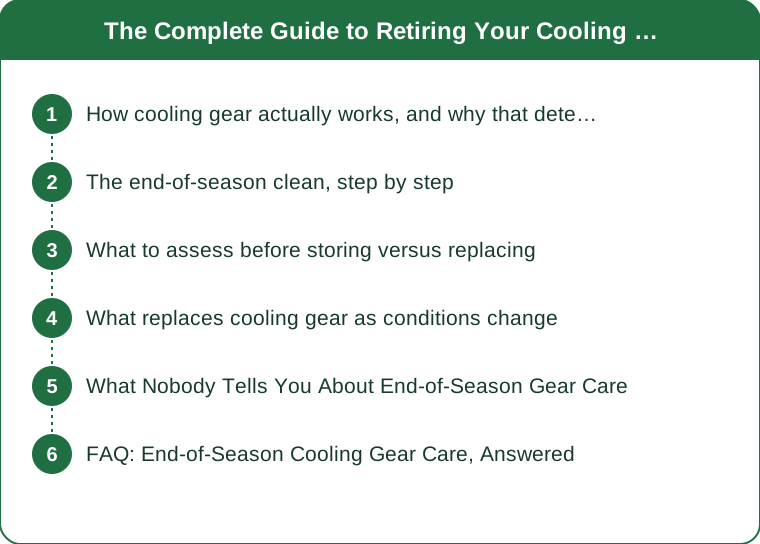
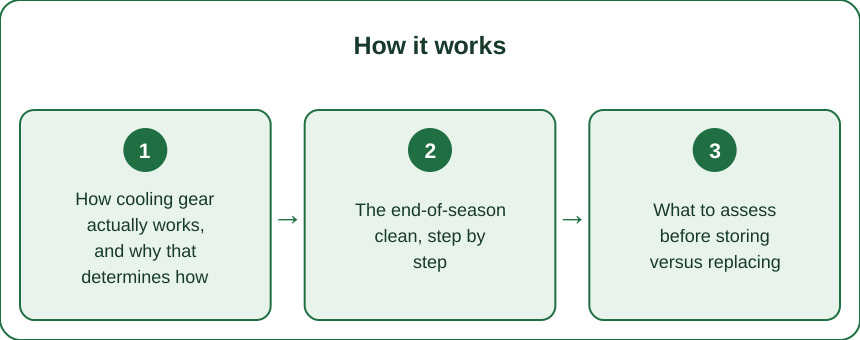
How cooling gear actually works, and why that determines how you store it
Understanding the mechanism explains every storage rule that follows.
Evaporative cooling towels. These are made from a hyper-absorbent synthetic - typically PVA or a specialised polyester weave - engineered to hold water in a structure that maximises surface area. Cooling occurs through evaporation, which draws heat from the surface it is in contact with. The material is designed to release water slowly, so evaporation continues over an extended period.
Why this matters for care: the same properties that hold water well also hold it well in a bag, which is why these towels are unusually prone to mildew and bacterial growth. A cooling towel packed damp will smell within a day or two, and once mildew has established in the fibre structure it is extremely difficult to remove.
Phase change cooling vests. These contain packs of material engineered to melt at a specific temperature, commonly in the 15 to 28 degree range depending on the product. They absorb heat as they change from solid to liquid, which is why they stay at a constant temperature rather than getting progressively warmer.
- Storage matters less for the packs themselves, which are stable, and more for the carrier garment
- Do not store them frozen indefinitely unless the manufacturer specifies it - repeated freeze cycles can degrade some formulations
Ice vests and gel packs. Simpler - they absorb heat through melting. The failure mode is a puncture or a slow leak, which is worth checking before storage rather than discovering next June.
Cooling sleeves and UPF garments. These work largely through UV blocking and moisture wicking rather than active cooling. The UPF rating degrades with wear, washing and stretch, and a garment that has been worn for two seasons is not delivering its rated protection.
The general principle emerging from all of it: cooling equipment is engineered around moisture behaviour, so moisture is also the thing that destroys it in storage.
The end-of-season clean, step by step
This is a 40-minute job once a year that determines whether the equipment works next season.
Cooling towels:
- Rinse thoroughly in cool water to remove salt, sunscreen and body oils. Sunscreen residue is the most common cause of degraded absorbency and it builds up invisibly.
- Hand wash in a mild detergent, or machine wash on a gentle cool cycle if the manufacturer permits
- Never use fabric softener. It coats the fibres and directly reduces water absorption - the entire function of the product.
- Never use bleach on PVA towels, which degrades the material
- Rinse until the water runs completely clear
- Dry completely. This is the step people skip. A towel that feels ‘nearly dry’ will mildew in a sealed box.
- Store loosely and dry, not in the sealed tube it came in. If storing in the tube, the towel must be bone dry first.
On the mildew question specifically: if a towel already smells, a soak in a solution of white vinegar and cool water for 30 minutes, followed by a thorough rinse and a complete dry, resolves mild cases. Established mildew usually means replacement, and using a mouldy towel against skin is not a good idea.
Cooling vests and phase change packs:
- Remove the packs and wash the carrier garment per its label
- Wipe the packs with a mild detergent solution and dry fully
- Inspect for leaks, splits and seam separation. A pack that has started leaking will fail completely next season.
- Store the packs flat, not compressed, at room temperature unless the manufacturer specifies otherwise
Cooling sleeves and UPF clothing:
- Wash normally, cool, no softener
- Assess the fabric - visible thinning, stretched-out elastic and faded colour all indicate reduced UPF performance
- Two hard seasons is a realistic replacement interval for UPF garments worn regularly
Insulated bottles and cooling accessories:
- Deep clean the lid and seal assembly, which is where the smell lives
- Store with the lid off so the interior dries and does not develop odour
- Check the vacuum seal - a bottle that no longer keeps drinks cold has lost its vacuum and cannot be repaired
What to assess before storing versus replacing
Storing something broken means discovering it is broken next June, which is the worst possible time.
Cooling towels - replace if:
- Absorbency has visibly declined - it no longer holds water the way it did
- There is persistent odour after a vinegar soak and thorough drying
- The material has stiffened permanently or shows visible degradation
- It has visible mildew staining
Realistic lifespan: one to three seasons of regular use, depending on care and sunscreen exposure.
Phase change and gel packs - replace if:
- Any leak, split or soft spot in the seal
- The material no longer solidifies properly at the stated temperature
- The carrier garment has damaged pockets that no longer hold packs in position
UPF garments - replace if:
- The fabric is visibly thinner when held to light
- Elastic has lost recovery at cuffs and hems
- It has been worn heavily for more than two seasons
- Colour has faded significantly, which correlates with reduced UV blocking in dyed fabrics
A note on buying at the end of season: this is when cooling equipment is heavily discounted. If you are replacing something, replacing it now costs considerably less than in May, and the assessment is easier to do while you remember how it performed.
A short written note in the storage box - what worked, what did not, what to buy - takes two minutes and saves the annual rediscovery in June.
Where to store it:
- Dry, room temperature, away from direct sunlight. UV degrades synthetic fabrics even in storage.
- Not in a garage or loft if those spaces get damp or reach extreme temperatures - both damage elastane and some phase change materials
- Loose rather than tightly compressed, which preserves elastic recovery

What replaces cooling gear as conditions change
The instinct is to swap cooling equipment for warm equipment, and that skips the actual transitional problem.
The transitional problem is moisture, not temperature. In late summer and early autumn you still sweat substantially, and the air is cooler. Sweat that would have evaporated in July now sits on the skin and cools you too much. Being cold and damp after exercise is the characteristic autumn complaint, and no amount of insulation fixes it if the base layer holds water.
What actually solves it - a three-layer approach:
- Base layer: synthetic or merino, fitted, whose only job is to move moisture off the skin. This is the layer that matters most and the one people spend least on.
- Mid layer: light insulation - a fleece, a grid knit - added and removed as needed
- Outer layer: wind resistance, which matters far more than most people realise. Wind strips warmth faster than low temperature does, and a light windproof shell is the highest-value autumn purchase.
Specific swaps that make sense:
- Cooling towel becomes a small quick-dry towel for post-session, serving the same bag slot
- Cooling vest becomes a light gilet - warms the core without restricting arms
- UPF sleeves become light arm warmers, which are removable mid-session and take no space
- Insulated bottle keeps working, now for hot drinks
What to keep accessible rather than storing:
- A cooling towel is genuinely useful indoors year-round for high-intensity sessions in a warm gym
- Anything for travel to warmer climates
- Keep one item out, store the rest
The most common transitional mistake: overdressing for the start of a session. You should feel slightly cold for the first five to ten minutes. If you are comfortable at the start, you will be overheating and sweating heavily by minute fifteen, which puts you right back into the damp-and-cold problem the layering was meant to solve.
What Nobody Tells You About End-of-Season Gear Care
Sunscreen is the primary killer of cooling towels, more than sweat or use. It coats the fibres and progressively reduces absorbency, and it does not rinse out with a quick cold rinse. A proper detergent wash at the end of every season is the single highest-value maintenance action.
‘Nearly dry’ is the mistake that ruins most gear. Synthetic materials feel dry on the surface while retaining moisture in the structure. Give anything absorbent a full 24 hours of air drying before it goes into a box, and store it somewhere with airflow rather than sealed.
Fabric softener is quietly destroying a lot of technical kit. It coats fibres to reduce friction, which is exactly the opposite of what a wicking or absorbent fabric needs. This applies to cooling towels, base layers, and every piece of moisture-managing kit you own.
UPF ratings degrade and nobody tracks it. A UPF 50 garment does not stay UPF 50 through two seasons of stretching, washing and UV exposure. Wet fabric also has substantially lower UPF than dry fabric, which is relevant for anyone who assumed a wet swim shirt was still providing rated protection.
Phase change packs have a temperature specification that is easy to misread. A pack rated for 21 degrees will not feel cold to the touch at room temperature - it is designed to hold a temperature, not to feel icy. People frequently conclude these products are broken when they are working as specified.
Insulated bottles fail silently. The vacuum seal degrades gradually, and drinks staying cool for six hours instead of twelve is easy not to notice. Test it once at the end of the season - fill with ice water and check after four hours.
End of season is the cheapest time to replace anything. Cooling equipment is discounted heavily from late August, and the assessment is far more accurate now than it will be after eight months of not thinking about it. Assess, replace, and store the replacement rather than the broken original.
FAQ: End-of-Season Cooling Gear Care, Answered
Why does my cooling towel smell even after washing?
Mildew established in the fibre structure, usually from being packed damp. A 30-minute soak in diluted white vinegar followed by a thorough rinse and complete drying resolves mild cases; established mildew means replacement.
Can I use fabric softener on cooling towels?
No. Softener coats fibres and directly reduces absorbency, which is the entire function of the product. The same applies to any moisture-wicking base layer.
How long do cooling towels last?
Typically one to three seasons of regular use. Sunscreen residue is the main cause of declining absorbency, so a proper detergent wash each season extends life considerably.
Should I store phase change packs in the freezer?
Only if the manufacturer says so. Many are designed to be stored at room temperature, and repeated freeze cycles can degrade some formulations.
Do UPF clothes stop working over time?
Yes. Stretching, washing, fading and UV exposure all reduce the rating, and wet fabric provides substantially less protection than dry. Two seasons of heavy use is a realistic replacement point.
What should I buy to replace cooling gear for autumn?
A good synthetic or merino base layer and a light windproof shell. Wind strips warmth faster than temperature does, and the base layer determines whether you end a session cold and damp.
TL;DR:
- Cooling gear is destroyed in storage far more often than in use - moisture is the enemy
- Wash out sunscreen residue, never use softener, and dry completely for 24 hours before boxing
- Inspect gel and phase change packs for leaks now rather than discovering them in June
- UPF garments lose their rating over about two seasons, and wet fabric protects far less than dry
- Replace what failed while it is discounted, and swap to a moisture-managing layer system rather than a warmer version of the same thing
The transitional problem is damp, not cold. Spend the storage hour properly, then put the money into a base layer and a windproof shell rather than more insulation.
See It in Motion
Seen here: UPF 50+ Racerback Yoga Tank Top — shop it on bubblelime.com
Keep Reading
This article is for general informational and styling purposes only. Fit, sizing, and product availability may vary.