The Complete Guide to Storing, Cleaning, and Retiring Your Cooling Gear
Quick Answer: Cooling gear fails in storage for three reasons: stored damp, which causes mould and permanent odour; stored compressed, which damages gel packs and PCM inserts; and stored hot, which degrades the phase-change materials and elastics. Wash everything according to its type, dry it completely, store loose and flat in a cool dark place, and check the expected lifespan of each item so you replace what is dead rather than rediscovering it next June.
Most people find out their cooling towel is ruined on the first hot day of next year, which is the worst possible moment to find out.

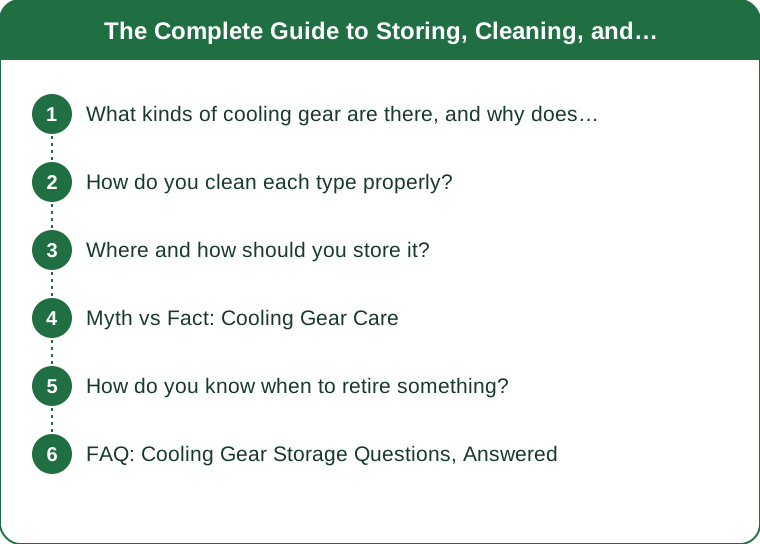
What kinds of cooling gear are there, and why does it matter?
Four categories with completely different care requirements, and treating them the same is the root of most storage failures.
1. Evaporative gear. Cooling towels, neck wraps, bandanas, cooling caps, and evaporative vests. These work by holding water in a specially structured fabric and cooling as it evaporates. They contain no gel and no chemicals in most cases - just a hyper-absorbent weave, usually PVA or a specialised polyester.
2. Phase change material gear. PCM vests, collars, and inserts. These contain a substance engineered to melt at a specific temperature - often around 15 to 28C depending on the product - absorbing heat as it changes state. They are recharged in cold water, a fridge, or a freezer depending on the material.
3. Gel and ice pack gear. Ice vests, gel packs, and frozen inserts. Simple, effective, heavy, and short-lived compared with the others.
4. Cooling fabrics and garments. Arm sleeves, shirts, and leggings marketed as cooling, which work through wicking, high air permeability, and sometimes a mineral coating that produces a cool-to-touch sensation. These are ordinary garments with ordinary care requirements, and the cooling effect degrades with the fabric finish.
Why the distinction matters for storage:
- Evaporative gear must be bone dry or it grows mould
- PCM inserts must not be crushed or overheated, which can damage the material or the containment
- Gel packs fail from puncture and from repeated freeze-thaw cycles
- Cooling fabrics lose their finish from heat, softener, and abrasion
The most common storage mistake by far is treating all of it as laundry - washing everything the same way and folding it into a box.
How do you clean each type properly?
Specifically, and the differences are meaningful.
Evaporative towels and wraps. These need cleaning more than anything else because they spend their life damp and against skin.
- Hand wash in warm water with a mild detergent, or machine wash gentle in a mesh bag if the label permits
- No fabric softener, ever. It coats the fibres and destroys the absorbency that is the entire mechanism
- No bleach, which damages PVA-type materials
- Rinse thoroughly. Detergent residue reduces absorbency almost as much as softener does
- Dry completely before storing. This is the critical step - a PVA towel stored damp will grow mould within days and the smell does not come out
PCM vests and inserts.
- Remove the inserts before doing anything to the shell
- Wipe the inserts with a damp cloth and mild soap; do not submerge unless the manufacturer says to
- Wash the shell according to its label, usually gentle and cool
- Never machine wash or tumble dry the inserts, and never microwave them
- Let the inserts return to room temperature before storing
Gel and ice packs.
- Wipe clean, inspect for leaks or thinning seams, and discard anything showing damage
- Never puncture or attempt to refill
Cooling garments.
- Cold wash, no softener, air dry. The same rules as any technical fabric
- Wash after every wear. Salt and body oils build up and reduce wicking, which is the actual mechanism in most of these garments
A general note on odour. Cooling gear that smells is holding bacteria in the fabric, and normal washing often fails to remove it because detergent residue is protecting the bacteria. A soak in a solution of white vinegar and water, followed by a thorough rinse and a wash with a light detergent dose, resolves most persistent odour. Sports-specific detergents also work. Do not use softener as a masking agent - it makes it worse.
Where and how should you store it?
Cool, dark, dry, loose, and flat. Four of those five are usually missed.
Temperature. Store somewhere that does not get hot. Loft spaces and garages are the two worst options and the two most commonly used. PCM materials in particular are engineered around specific temperature thresholds, and repeated heat cycling in a loft can degrade them. Elastics degrade with heat too.
Light. UV degrades synthetic fabrics and plastics. A cupboard or a box, not a shelf near a window.
Humidity. A damp cupboard undoes careful drying. If storage is anywhere prone to damp, a silica gel sachet in the box costs almost nothing.
Compression. This is the one nobody thinks about. Gel packs and PCM inserts stored under heavy items can develop weak points and split, and evaporative fabrics stored tightly compressed hold creases that become permanent weak lines. Store loose and flat.
A workable system:
- Clean everything and dry it completely - fully dry, not nearly dry
- Remove inserts from vests and store them flat and separate
- Put fabrics in a breathable bag or a box with a loose lid, not a sealed plastic bag
- Put the box in an internal cupboard rather than a loft, garage, or shed
- Label it with the date and a note of anything that needs replacing
On that last point: the label is what saves you next summer. A note saying two towels replaced, vest inserts due, means the first hot day is not spent discovering problems.
Do not store PCM inserts in the freezer over winter unless the manufacturer specifies it. Long-term freezing is unnecessary, uses space, and for some materials involves unnecessary cycling.

Myth vs Fact: Cooling Gear Care
Myth: Cooling towels do not need washing because you only use them with water. Fact: They are held against skin in heat and sweat, which makes them one of the most bacteria-friendly items you own. They need washing more often than most gym kit, not less.
Myth: Fabric softener makes them softer and better. Fact: It coats fibres and destroys absorbency, which is the entire mechanism of an evaporative towel. This is the single most damaging thing you can do to cooling gear.
Myth: Cooling gear lasts indefinitely if you look after it. Fact: Evaporative fabrics lose absorbency over time as fibres break down, PCM materials can degrade with repeated heat cycling, and gel packs eventually fail. Everything here has a lifespan - the care determines whether it is two seasons or five.
Myth: A cooling vest works better the colder you make it. Fact: PCM vests are engineered around a specific melt temperature. Freezing a PCM insert designed for 15C does not make it better - it makes it uncomfortably cold at first and then it performs the same, and for some materials it is explicitly not recommended.
Myth: You can store everything in a sealed plastic box for maximum protection. Fact: Sealed plastic traps any residual moisture, which is exactly how mould develops. Breathable storage with a loose lid is better.
Myth: If it smells, it is dirty and needs a stronger wash. Fact: Persistent odour is usually bacteria protected by detergent residue. More detergent makes it worse. A vinegar soak and a lighter detergent dose is the fix.
How do you know when to retire something?
Specific signs by type, and it is worth checking at storage time rather than at first use.
Evaporative towels and wraps - replace when:
- It no longer holds water well or dries out much faster than it used to. This is the main functional failure
- The texture has gone stiff, papery, or crumbly, which indicates fibre breakdown in PVA materials
- There is any mould staining, which does not wash out and which you should not hold against your skin
- Persistent odour survives a vinegar soak
Typical lifespan varies enormously by material and use, and heavy use across a full summer is a reasonable expectation for a cheap towel, with better products lasting several seasons.
PCM vests and inserts - replace when:
- An insert no longer solidifies at its rated temperature, or takes far longer than it used to
- The insert feels lumpy or unevenly distributed, which can indicate degradation
- Any seam, seal, or containment is damaged. Do not use a damaged insert
- The shell has lost its structure or the fastenings have failed, which is often the first thing to go
Gel and ice packs - replace when:
- Any leak, thinning, or bulge appears. Immediately, and dispose of it properly
- It no longer freezes solid
- Note that gel packs are consumables and generally have the shortest life of anything here
Cooling garments - replace when:
- The fabric has pilled or thinned significantly, particularly at friction points
- Wicking has stopped working - the test is whether sweat spreads and dries or sits
- Persistent odour, which in synthetics eventually becomes permanent
A practical end-of-season routine, in about thirty minutes:
- Gather everything in one place, which is itself informative - most people own more than they remember
- Test each item briefly. Does the towel absorb? Does the insert freeze? Any leaks?
- Discard what has failed. Do this now rather than storing it, or you will store it and rediscover it next year
- Clean and fully dry what remains
- Store loose, flat, cool, and dark
- Write the date and a shopping note on the box
On disposal, briefly. Gel packs should not be emptied down the drain in bulk and are generally not recyclable through kerbside collection - check local guidance. PVA cooling towels are synthetic and not compostable despite occasional marketing claims. Buying fewer, better items and maintaining them is the meaningful environmental choice here, and it is also the cheaper one over a few seasons.
One forward-looking note. If you are replacing anything, the end of the hot season is when cooling gear goes on sale, and it is a considerably better time to buy than the first hot week of next summer when stock is short and prices are not.
FAQ: Cooling Gear Storage Questions, Answered
Can I store a cooling towel damp?
No. It will grow mould within days and the odour and staining are permanent. Complete drying before storage is the single most important step.
Should I keep PCM inserts in the freezer over winter?
Not unless the manufacturer specifies it. It uses space unnecessarily and involves cycling the material for no benefit.
Why does my cooling towel not work as well as it used to?
Usually fabric softener or detergent residue coating the fibres, or fibre breakdown from age. Try a vinegar soak and a thorough rinse; if it still dries fast, it is done.
Where is the worst place to store cooling gear?
A loft or garage. Both cycle through significant heat, which degrades PCM materials, elastics, and plastics.
How long does cooling gear last?
It varies widely - a cheap evaporative towel may manage a season or two of heavy use, while a good PCM vest can last several years with proper care. Test each item at the end of the season rather than assuming.
Is it worth buying cooling gear at the end of summer?
Yes - it is when prices drop and stock clears. Replacing failed items now is considerably cheaper than replacing them in the first heatwave.
TL;DR:
- Cooling gear dies in storage, not in use: stored damp, stored compressed, or stored hot
- Never use fabric softener on evaporative towels - it destroys the absorbency that is the entire mechanism
- Remove PCM and gel inserts before washing the shell, and store them flat, loose, and at room temperature
- Store cool, dark, dry, and breathable - not a loft, not a garage, not a sealed plastic bag
- Test everything at the end of the season and discard failures now rather than rediscovering them next June
Thirty minutes at the end of the hot season, and a label on the box, is the difference between working gear and a box of disappointments next summer.
See It in Motion
Seen here: High Waist Embossed Yoga Leggings with Side Pockets — shop it on bubblelime.com
Keep Reading
This article is for general informational and styling purposes only. Fit, sizing, and product availability may vary.