The Complete Guide to Cooling Gear for Homes Without Air Conditioning
Quick Answer: Cooling a home without air conditioning is three separate jobs, and most people only do the third. Keep heat out with blackout blinds and closed windows during the day - an open window in 32C air heats the room. Get heat out with a cross-ventilation window schedule and an extractor or window fan pushing air out once the outside temperature drops below the inside. Cool yourself rather than the room, with airflow across skin, evaporative cooling at the pulse points, and the right bedding. The single highest-value item is not a fan - it is a proper blackout blind on the sun-facing window, because heat prevented never has to be removed.
The house is hotter than outside by six in the evening and nobody can explain why.

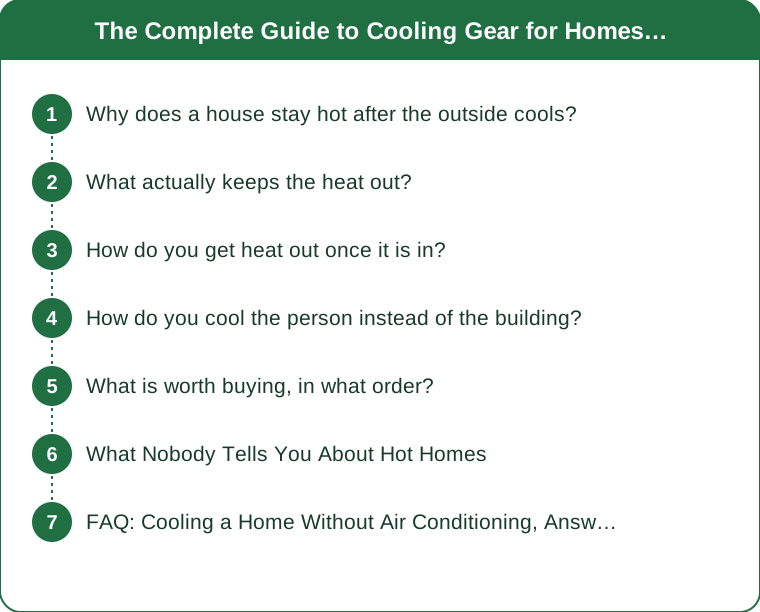
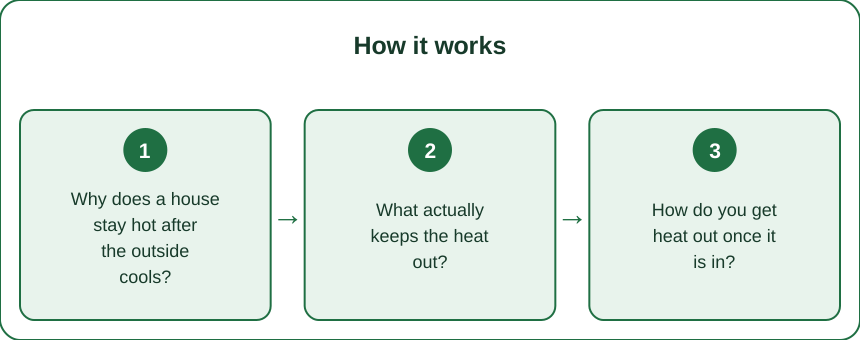
Why does a house stay hot after the outside cools?
Because of thermal mass and because of when you open the windows.
Buildings absorb heat all day - through glazing as direct solar gain, through walls and roofs as conducted heat, and from everything inside that generates it. Masonry, plaster, and concrete store that heat and then release it slowly for hours. This is why the peak indoor temperature typically arrives two to six hours after the outdoor peak, and why a flat can be at its worst at 9pm on a day that stopped being hot at 6pm.
Solar gain through glass is the biggest single input in most homes. Sunlight through a window is converted to heat when it lands on floors and furniture, and that heat is then trapped inside - the greenhouse effect at domestic scale. A south or west-facing window with no shading can admit a very large amount of heat over an afternoon, and it does not matter how well insulated the walls are.
The roof is second, which is why top-floor flats and loft bedrooms are dramatically worse than the floor below.
Internal gains are third and are underestimated. An oven, a tumble dryer, a hot shower, a desktop computer, old lighting, and people all add heat. A tumble dryer running in a flat on a hot day is genuinely counterproductive.
The window timing mistake. Opening windows when it is hotter outside than inside brings heat in. The correct rule is simple and almost nobody follows it: windows closed and shaded while the outside air is hotter than the inside; windows wide open once the outside air is cooler. In practice that usually means shut from mid-morning to early evening, open from evening through the night, shut again in the morning.
Which sets up the strategy for the rest of this guide: prevent, then purge, then cool the person. In that order, because each stage is cheaper and more effective than the one after it.
What actually keeps the heat out?
This is the highest-return category and the one people skip because it feels less active than buying a fan.
External shading beats internal shading by a wide margin. Anything that stops sunlight before it passes the glass prevents the heat entirely; anything inside the glass has already let it in and is only stopping it reaching the floor.
- External shutters, awnings, or shade sails are the gold standard where available.
- External roller blinds on the worst window are transformative for a top-floor room.
- Even a temporary option - a sheet or shade cloth clipped outside a window on the sunny side - materially outperforms an internal blind.
Internal options, which are what most people can actually do:
- Blackout blinds or lined curtains, closed before the sun reaches the window, not after. The timing matters - once the room is hot, the blind is only preventing more.
- Light-coloured, reflective backing on curtains, which bounces some radiation back out through the glass.
- Reflective window film on the worst-facing window. It cuts solar heat gain year-round, which is a genuine trade-off if that room is cold in winter.
Reduce internal gains, which costs nothing:
- Do not use the oven in the evening. Cook outdoors, use a microwave, an air fryer, or an electric hob with a lid, or eat cold. An oven at 200C for an hour is a substantial heat source in a small flat.
- Dry laundry outside or overnight, never with a tumble dryer in the afternoon.
- Switch remaining halogen or incandescent bulbs to LED, which convert far less energy to heat.
- Shut down and unplug what you are not using. Individually small, collectively noticeable in a small room.
- Shower cooler and use the extractor fan, or heat and humidity both stay in the flat.
Close internal doors to unused hot rooms, so heat is contained rather than distributed.
How do you get heat out once it is in?
This is where fans earn their place, and it is not the way most people use them.
Cross ventilation is the mechanism. Air needs an inlet and an outlet, ideally on opposite sides of the space. Opening one window in a room produces very little exchange; opening two on different walls produces a genuine flow. Prop internal doors open to connect the path.
The window fan trick, which is the most underrated tactic here. Once the outside air is cooler than the inside, put a fan in a window facing outward to push hot air out. That creates negative pressure and draws cool air in through other windows. A single fan used this way moves far more heat than the same fan blowing around a closed room.
Stack ventilation. Heat rises, so if you have a two-storey home or a stairwell, opening a high window and a low window creates a chimney effect that runs on its own. Opening the loft hatch is a common mistake in the opposite direction - it lets stored roof heat down.
Timing, in practice:
- Late evening onward: everything open. This is the main purge window and the longer it runs, the cooler the building’s mass gets.
- Overnight: keep it open if security allows. Window restrictors and locked-open positions exist for exactly this.
- Early morning: open wide - this is often the coolest air of the whole day and the best chance to cool the structure itself.
- Mid-morning: close everything and shade it, before the outside temperature passes the inside temperature. Check with a cheap indoor-outdoor thermometer rather than guessing; this is the decision people get wrong most often.
Extractor fans are underused. Kitchen and bathroom extractors are outlets you already own. Running the kitchen extractor while cooking, and for a while afterwards, removes both heat and humidity.
What does not work: a fan in a sealed room. It makes you feel cooler by moving air over your skin, which is genuinely useful, but it adds a small amount of heat from the motor and removes none from the room.

How do you cool the person instead of the building?
This is where the actual gear comes in, and it is far cheaper than cooling air.
The physiology in one paragraph: you lose heat through radiation, convection, conduction, and evaporation. When air temperature approaches skin temperature, radiation and convection stop working and evaporation becomes almost the only route. Evaporation depends on humidity - which is why humid heat is so much harder to tolerate, and why a fan stops helping above a certain point.
Airflow across skin - the cheapest, most effective tool.
- A fan aimed at you, not at the room. Moving air accelerates evaporation from skin and strips the warm boundary layer away.
- A damp cloth or a light mist on the skin with a fan on it multiplies the effect substantially. This is the mechanism behind every cooling towel.
- Important limit: in extreme heat above roughly 35C with high humidity, a fan blowing hot air can add heat rather than remove it. Wetting the skin restores the benefit, which is the recommended approach in heatwave guidance.
Evaporative cooling gear that genuinely works at home:
- Cooling towels - the PVA type - draped on the back of the neck. Re-wet as they dry.
- A spray bottle of water by the bed and on the desk. Unglamorous and highly effective with a fan.
- Cool water on the wrists, the inside of the elbows, and the feet - places where blood runs close to the surface.
- A bowl of cool water for the feet while sitting. Feet have a lot of surface vasculature and this works better than it sounds.
For sleeping, which is the hardest part:
- Sleep low - heat rises, so a floor mattress in a hot bedroom is genuinely cooler than a high bed.
- Natural fibre bedding, cotton or linen, in a single light layer. Linen in particular breathes and wicks well.
- A cool shower before bed, then let yourself air dry.
- Damp a flannel and put it on the back of the neck, or freeze a hot water bottle filled with water and put it at the feet.
- Warm feet is the rule in normal conditions and cool feet is the rule in heat - in a hot room, cooling the feet accelerates the core temperature drop that sleep onset requires.
Clothing: loose, light-coloured, natural fibres. Loose matters more than thin, because it allows air movement between fabric and skin.
What is worth buying, in what order?
Ordered by cooling delivered per unit spent, which is not the order shops present.
1. A blackout blind or lined curtain for the worst window. Prevents heat rather than removing it, works passively, costs less than most fans, and is the item people buy last.
2. A basic thermometer that reads indoor and outdoor temperature. Removes the guesswork from the window schedule, which is the single most impactful behaviour change available. Very cheap.
3. A decent fan. A pedestal or tower fan with a timer and enough throw to reach the bed. Prioritise airflow volume over gadgets. A second cheap fan for window-out duty is better value than one expensive fan.
4. Cooling towels, two or three. Rotate them - one on the neck, one soaking.
5. Light bedding. A linen or lightweight cotton set used only in hot months.
6. Reflective window film, if one window is clearly the problem and you cannot shade it externally.
7. An evaporative cooler, with caveats. These add humidity to the air, which helps in dry heat and makes things distinctly worse in humid climates. In a humid summer they can be counterproductive, and that is not always clear from the packaging.
8. A portable air conditioner - last, and know the trade-off. Single-hose units expel hot air through a duct and create negative pressure that pulls warm air in from elsewhere, so real-world performance is well below the rating. They are noisy, use significant electricity, and require a window seal. A dual-hose unit is meaningfully better. If nothing else has worked and the heat is affecting health or sleep, it is a legitimate purchase - just go in with accurate expectations.
What to skip: personal misting fans that are too small to move real air, wearable neck fans for indoor use, and anything sold as a cooling gadget that does not either block sun, move air, or wet skin. Those three mechanisms are the entire field.
What Nobody Tells You About Hot Homes
Humidity decides whether any of this works. In dry heat, evaporative methods are extremely effective. In humid heat, sweat does not evaporate and every evaporative tool loses most of its power - which is why the same advice produces wildly different results in different places. In humid conditions, prioritise airflow and dehumidification over misting.
A dehumidifier can make a humid room feel meaningfully cooler without lowering the temperature, because it restores your ability to evaporate sweat. It also adds a little heat from the motor, so it is a trade-off - but in a muggy flat it is frequently the better buy than another fan.
The coolest air of the day is usually just before sunrise, not late at night. If you can only ventilate once, the pre-dawn hour cools the building’s mass most.
Fridges and freezers work harder in hot rooms and dump that heat into the room. Keeping the coils clear and the door closed genuinely matters in a small kitchen.
Houseplants help marginally through transpiration but add humidity, which is the wrong direction in muggy conditions.
Ceiling fans should run counterclockwise in summer, pushing air down. Many are left in winter mode all year, which produces an updraught and no cooling sensation.
Heat affects health, not just comfort. Older adults, very young children, pregnant people, and anyone with heart, lung, or kidney conditions or on certain medications are considerably more vulnerable. Signs to act on: dizziness, confusion, headache, nausea, a fast weak pulse, or stopping sweating in heat. Move to the coolest space, cool the skin, and drink water - and get medical help urgently if there is confusion, fainting, or a very high temperature.
A cool space you can leave for is a legitimate part of the plan. A library, a shopping centre, a cinema, or a friend’s cooler flat during the worst four hours of the day is not a failure of your setup - it is the recommendation.
This is general information, not medical advice. If you or someone else shows signs of heat exhaustion or heatstroke, seek medical help promptly.
FAQ: Cooling a Home Without Air Conditioning, Answered
Should I keep the windows open or closed during a hot day?
Closed and shaded whenever the outside air is hotter than the inside air, open whenever it is cooler. A thermometer that reads both removes the guesswork, and this one decision makes more difference than most purchases.
Does a bowl of ice in front of a fan work?
Modestly, and briefly. It cools the air passing over it and adds humidity as it melts, which is fine in dry heat and unhelpful in humid heat. It is a short-term trick rather than a strategy.
Is it worse to sleep with a fan on all night?
For most people it is fine. Some experience dry eyes, a dry throat, or nasal irritation from direct airflow, which is usually solved by aiming it across the bed rather than at your face, or using oscillation.
Why is my bedroom hotter than the rest of the house?
Usually the roof and the west-facing window. Top-floor and loft rooms absorb the most solar gain and vent the least, and bedrooms are often the room with the least airflow because the door is closed.
Do those reflective window films really work?
Yes, meaningfully, on windows with direct sun. The trade-off is that they work year-round, so a room that is cold in winter will get slightly colder. Applying to the worst one or two windows rather than all of them is the usual compromise.
Is a portable air conditioner worth it?
If the heat is affecting sleep or health and the passive measures have been exhausted, yes - with realistic expectations. A dual-hose unit performs considerably better than a single-hose one, and both need a proper window seal to work at all.
TL;DR:
- Three jobs in order: keep heat out, purge heat once it is in, then cool the person. Most people only do the third.
- Solar gain through glass is the biggest input. External shading beats internal; a blackout blind on the worst window beats a fan for value.
- Windows closed and shaded while it is hotter outside; wide open once it is cooler - and a fan in a window facing outward moves far more heat than one blowing round a closed room.
- Evaporation is the only cooling route once air approaches skin temperature. Damp skin plus airflow, cool water at wrists and feet, light natural bedding.
- Humidity decides everything - evaporative gear fails in muggy heat, where a dehumidifier often beats another fan.
Buy the blind and the thermometer before you buy the third fan. Heat you never let in is heat you never have to move.
See It in Motion
Seen here: High Waist Yoga Leggings with Side Pockets — shop it on bubblelime.com
Keep Reading
This article is for general informational and styling purposes only. Fit, sizing, and product availability may vary.