Heat Exhaustion vs. Heat Stroke: The Complete Guide to Spotting the Warning Signs Before It's Too Late
Quick Answer: Heat exhaustion involves heavy sweating, weakness, and nausea while your body is still cooling itself; heat stroke is a medical emergency marked by hot, often dry skin, confusion, and a body temperature above 103°F where the cooling system has failed entirely. Knowing which stage you’re in determines whether you need water and shade, or a 911 call.
Most summer workout guides tell you to ‘stay hydrated and take breaks,’ which is true but not specific enough when you’re actually starting to feel bad mid-run. This is the more detailed version — what each stage of heat illness actually looks like physiologically, what to do at each one, and why the distinction between the two conditions matters far more than most casual advice treats it.

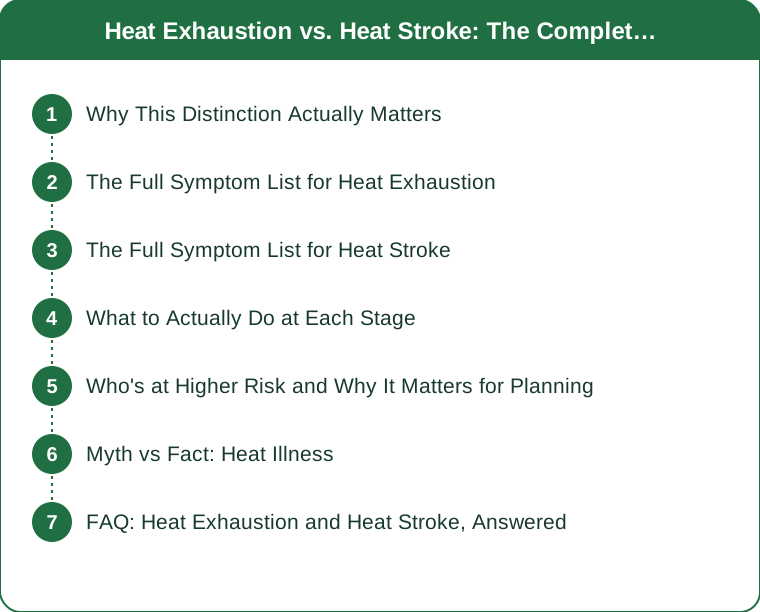
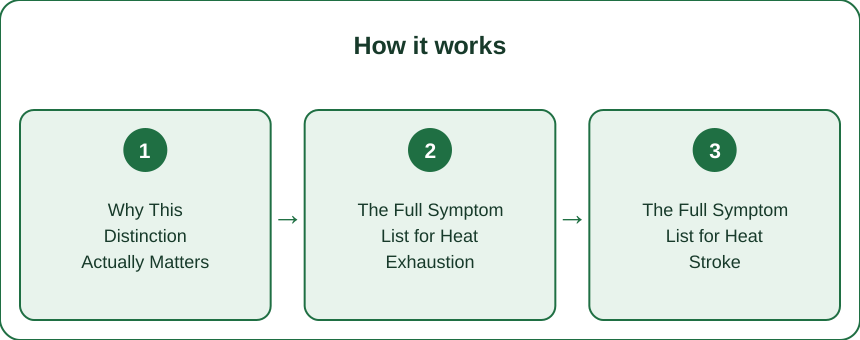
Why This Distinction Actually Matters
Heat exhaustion and heat stroke aren’t two unrelated conditions — heat stroke is what heat exhaustion becomes when it’s not addressed and your body’s cooling mechanism (sweating) starts to fail. The practical stakes of telling them apart are high: heat exhaustion responds well to rest, water, and shade within 30-60 minutes, while heat stroke is a true medical emergency requiring immediate professional care, and treating it like ordinary heat exhaustion can be dangerous, even fatal without rapid cooling and medical treatment.
Knowing the specific signs of the transition point is the single most useful piece of heat safety information you can carry into a hot workout, because the progression from one stage to the other can happen faster than most people expect — sometimes within 30 minutes to an hour once cooling mechanisms genuinely start to fail, rather than the gradual multi-hour decline people often picture.
The Full Symptom List for Heat Exhaustion
Heat exhaustion typically presents as heavy, persistent sweating alongside cool, clammy, pale skin — your body is actively and still successfully cooling itself, just at its limit. Alongside the sweating, watch for a fast but weak pulse, muscle cramps (sometimes called heat cramps, often in the calves, abdomen, or arms), nausea or vomiting, dizziness, headache, and a feeling of general weakness or fatigue that’s more intense than normal workout fatigue.
Body temperature is usually elevated but stays below 104°F. Crucially, the person is still alert and can usually describe how they’re feeling accurately, even if uncomfortable — this alertness is itself a meaningful diagnostic sign, since its absence or degradation is one of the clearest markers of progression toward heat stroke. Some people also report a sense of impending doom or unusual anxiety during heat exhaustion, which is worth taking seriously as a symptom rather than dismissing as unrelated nervousness.
The Full Symptom List for Heat Stroke
Heat stroke represents cooling system failure. The clearest distinguishing sign is skin that becomes hot and can turn dry (sweating stops or drastically reduces because the cooling mechanism has broken down), alongside a body temperature typically above 103°F, sometimes considerably higher. The more urgent signs are neurological: confusion, slurred speech, agitation, disorientation, or in severe cases, loss of consciousness or seizures.
A rapid, strong pulse (rather than the weak pulse of heat exhaustion) is also common, along with rapid, shallow breathing. Any confusion or altered mental state during a hot workout should be treated as a possible heat stroke until proven otherwise — this is genuinely the single most important sign to watch for, since it’s both distinctive and urgent, and people experiencing it are frequently unable to recognize or report it about themselves, which is exactly why training partners and workout buddies should also know these signs, not just the person at risk.

What to Actually Do at Each Stage
For heat exhaustion: stop activity immediately, move to shade or air conditioning, remove excess clothing, sip water (not gulp large amounts at once), and apply cool, wet cloths to the neck, armpits, and groin — areas with major blood vessels close to the skin where cooling has an outsized effect on core temperature. Symptoms should meaningfully improve within 30-60 minutes; if they don’t, or if they worsen, treat it as a possible progression to heat stroke rather than waiting longer to see.
For suspected heat stroke: call 911 immediately — this is not a wait-and-see situation, and delaying the call to ‘see if it passes’ is one of the most dangerous mistakes possible in this scenario. While waiting for help, move the person to shade, remove excess clothing, and cool them as aggressively as possible with cold water, ice packs to the neck/armpits/groin, or immersion if available — aggressive active cooling before EMS arrives has been shown to meaningfully improve outcomes. Do not give fluids by mouth if the person is confused or not fully alert, due to choking risk.
Who’s at Higher Risk and Why It Matters for Planning
Sweating only cools the body if the sweat can actually evaporate off the skin — evaporation is the physical process that carries heat away, not the sweat itself sitting on the skin. In high humidity, the surrounding air is already close to saturated with moisture, which slows evaporation dramatically even though sweat production stays the same or increases, meaning the body keeps producing its main cooling mechanism while that mechanism becomes progressively less effective. This is exactly why heat index (which factors in humidity) is a far more useful number to check before a workout than raw air temperature alone — a 90°F day at 70% humidity can carry a heat index well above 100°F and pose more real heat-illness risk than a dry 100°F day where sweat evaporates efficiently. Cooling gear designed around evaporative principles (cooling towels, evaporative vests) works by supplementing this same mechanism, which is also why that gear is measurably less effective in very high humidity than in dry heat — it’s fighting the same physics the body itself is struggling against.
Beyond humidity, other factors meaningfully raise heat illness risk: certain medications (some blood pressure medications and antihistamines impair heat regulation), being unacclimated to heat (the first hot week of the season is consistently higher-risk than deep summer), and dehydration going into the workout. Age is also a factor worth noting — both very young and older adults have less efficient thermoregulation, and certain chronic conditions (cardiovascular disease, diabetes) can impair the body’s cooling response as well.
Heat acclimation itself is a real, measurable physiological adaptation: over roughly 10-14 days of repeated heat exposure, the body starts sweating earlier and more efficiently, and blood plasma volume expands slightly to support better heat dissipation, which is why the same workout that felt dangerous in week one of summer often feels manageable by week three. Planning around these factors — checking heat index rather than raw temperature alone, allowing that 10-14 day acclimation window each season, and starting workouts well-hydrated rather than trying to hydrate through them — meaningfully lowers risk before symptoms ever start.
Myth vs Fact: Heat Illness
Myth: if you’re sweating heavily, you’re not at risk of heat stroke yet. Fact: heavy sweating is actually the sign of heat exhaustion, the stage before heat stroke — the danger sign to watch for is the opposite, when sweating suddenly decreases or stops despite still feeling overheated, which can signal the shift into heat stroke.
Myth: drinking more water during the workout prevents heat illness entirely. Fact: hydration status going into a hot workout matters more than what you drink during it — you can’t out-drink heat illness risk mid-workout if you started dehydrated, and overdrinking water alone (without electrolytes) during extreme heat can create its own separate problem, dangerously low blood sodium known as hyponatremia.
Myth: fit, experienced athletes are essentially immune to heat stroke. Fact: fitness level provides some protective benefit through better heat acclimation, but well-conditioned athletes still experience heat stroke, sometimes specifically because their fitness lets them push through early warning signs that a less conditioned person would have stopped for earlier.
FAQ: Heat Exhaustion and Heat Stroke, Answered
How quickly can heat exhaustion turn into heat stroke?
It can progress within 30 minutes to an hour if activity continues and cooling measures aren’t taken, though the exact timeline varies by individual, humidity, and exertion level — which is exactly why stopping at the first heat exhaustion signs matters rather than pushing through and hoping it resolves on its own.
Should I keep exercising if I just feel a little overheated but not clearly sick?
No — mild symptoms are the easiest and safest point to intervene; stopping, cooling down, and reassessing costs you a few minutes, while pushing through risks a much longer recovery or a genuine emergency that costs considerably more than the workout you’re trying to protect.
Is heat stroke risk different for outdoor workouts versus a hot indoor gym?
The same core risk factors apply in both settings, but outdoor heat combined with direct sun and humidity typically raises risk faster than an indoor space, even a warm one, because there’s no shade or ventilation control available, and radiant heat from direct sun adds a meaningful load beyond ambient air temperature alone.
What should I actually do differently if I’m exercising with someone else versus alone in the heat?
Working out with a partner in hot conditions has a genuine safety advantage specifically because confusion — one of the clearest heat stroke warning signs — is something a person experiencing it often can’t recognize in themselves; agree beforehand that either person can call a stop to the workout at the first sign of concern, without needing the other’s agreement first.
Does cooling gear like vests or towels actually prevent heat illness, or just make a workout more comfortable?
Cooling gear can genuinely help delay the onset of heat exhaustion by supplementing the body’s own evaporative cooling, particularly in dry heat where evaporation already works well and the gear adds to it, but it doesn’t remove the need for hydration, pacing, and stopping at the first warning signs — it’s a supporting tool, not a substitute for recognizing and responding to actual symptoms.
How long after a heat exhaustion episode is it safe to resume normal training?
Most mild cases clear within 24-48 hours of proper rest and rehydration, but returning to full-intensity training immediately after symptoms resolve, rather than easing back in over a couple of days, raises the risk of a repeat episode before the body has fully recovered its fluid and electrolyte balance.
Are electrolyte drinks actually necessary, or is plain water enough for most workouts?
For workouts under an hour in moderate conditions, plain water is generally sufficient; once a session stretches past an hour in real heat, or involves heavy sweating, electrolyte replacement (particularly sodium) becomes more relevant, since sweat carries out meaningful electrolytes alongside water and replacing water alone can dilute remaining sodium levels during very prolonged heavy sweating.
Do children and older adults need different precautions in the heat?
Yes — children generate more heat relative to body size during exercise and sweat less efficiently than adults, while older adults often have a blunted thirst response and may be on medications affecting heat regulation, so both groups warrant more conservative activity timing and closer symptom monitoring than a healthy adult in their prime years.
This is general safety information, not medical advice — if you or someone with you shows signs of heat stroke, call emergency services immediately rather than waiting to see if symptoms resolve.
TL;DR:
- Heat exhaustion: heavy sweating, cool clammy skin, weakness, still alert — respond with rest, shade, and water
- Heat stroke: hot/dry skin, confusion, temperature above 103°F — call 911 immediately, this is an emergency
- The scariest myth is that sweating means you’re safe — decreased sweating despite feeling overheated is actually a warning sign
- Humidity, certain medications, age, and lack of heat acclimation all raise risk independent of the thermometer reading
- Fit athletes aren’t immune — fitness can actually mask early warning signs, letting people push further before stopping
The single most useful habit from all of this is simple: stop and cool down at the first heat exhaustion sign, rather than deciding whether it’s ‘bad enough’ to justify pausing. That decision made early is what keeps it from ever becoming an emergency.
See It in Motion
Seen here: High Waist Embossed Yoga Leggings with Side Pockets — shop it on bubblelime.com
Keep Reading
This article is for general informational and styling purposes only. Fit, sizing, and product availability may vary.