The Honest, Detailed Guide to Buying a Cooling Vest That Actually Works
Quick Answer: Evaporative cooling vests work best in dry heat and are lightweight and affordable; phase-change (ice pack) vests work in any humidity but are heavier and need a freezer; the right choice depends on your climate and how long you need cooling to last — not on price alone.
Cooling vests aren’t one product category — they’re at least three genuinely different technologies with different strengths, and picking based on price or marketing claims alone often means ending up with the wrong type for your actual climate and use case.

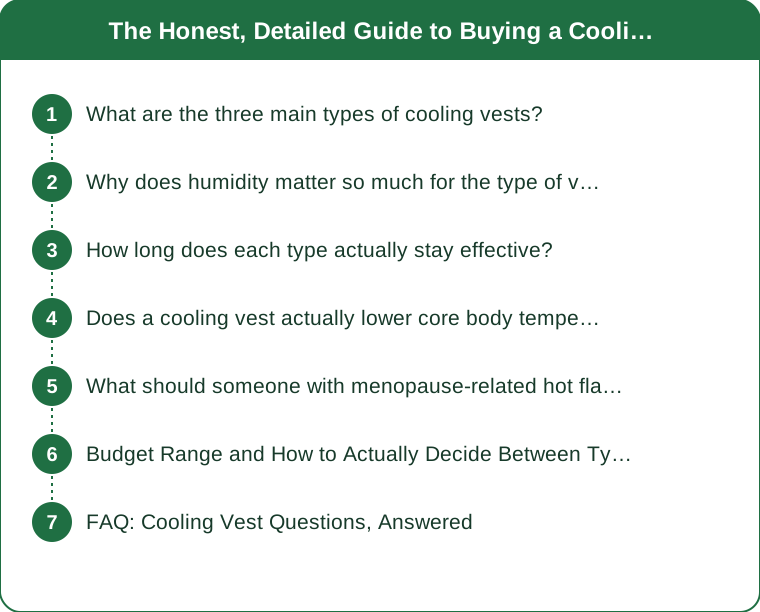
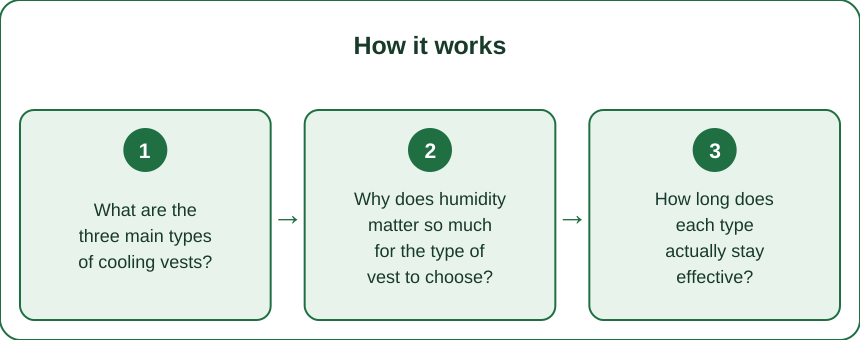
What are the three main types of cooling vests?
Evaporative vests use water-absorbent fabric that cools through evaporation as it dries — lightweight, reusable instantly by re-wetting, but dependent on low humidity to work well. Phase-change (ice pack) vests use gel packs frozen beforehand — work in any humidity level, provide more consistent cooling, but are heavier and require freezer access and planning ahead. Air-circulating (fan) vests use small battery-powered fans to move air across the body — lighter than ice vests, work in most climates, but need battery charging and add mechanical bulk.
Why does humidity matter so much for the type of vest to choose?
Evaporative cooling relies on water evaporating off the fabric surface, and evaporation slows dramatically in high humidity — the same vest that feels dramatically cooling in Arizona’s dry heat may do almost nothing in Florida’s humidity. This single factor eliminates evaporative vests as the right choice for a large portion of climates, regardless of how well-reviewed a specific product is.
How long does each type actually stay effective?
Evaporative vests typically need re-wetting every 1-3 hours depending on heat and airflow, making them well suited for activities with water access nearby. Phase-change ice vests generally provide 1.5-2.5 hours of consistent cooling before the gel packs warm to ambient temperature, then require re-freezing — a real logistical constraint for all-day use. Air-circulating vests run as long as their battery lasts, typically 4-8 hours depending on fan speed, but provide milder cooling than the other two types since they move air rather than actively lower temperature.

Does a cooling vest actually lower core body temperature, or just feel cooler?
Evidence varies by type and use case — phase-change vests used for genuine pre-cooling before intense heat exposure have more direct research support for measurably lowering core temperature, particularly in athletic and occupational heat-safety contexts. Evaporative and fan vests more reliably improve perceived comfort and skin temperature, which matters for tolerability and performance even without necessarily producing a large core temperature change — both benefits are real, just different in magnitude and mechanism.
What should someone with menopause-related hot flashes look for specifically?
A lightweight, low-profile evaporative or small ice-pack neck wrap — rather than a full torso vest — is often more practical for intermittent, unpredictable heat episodes throughout a day, since it can be applied quickly to the neck (a highly effective cooling zone due to blood vessel proximity to the skin) without needing to remove or wear a full garment continuously.
Budget Range and How to Actually Decide Between Types
What’s a reasonable budget range, and does price predict quality here?
Evaporative vests range roughly $20-60 and price correlates loosely with fabric quality and durability. Phase-change vests range $40-150+, with price more strongly tied to gel pack quality, coverage area, and how evenly packs distribute across the torso — a poorly designed higher-priced vest can still underperform a well-designed cheaper one, so checking coverage design specifically matters more than price alone.
How should someone actually decide between the three types?
Start with climate: dry heat favors evaporative, humid heat favors phase-change or fan. Then consider session length: short sessions (under 90 minutes) suit any type, longer sessions favor fan (battery-powered, no re-wetting or re-freezing needed) or a stockpile of extra ice packs for phase-change. Budget and logistics (freezer access, battery charging habits) are the final filter once climate and duration have narrowed the choice.
FAQ: Cooling Vest Questions, Answered
Can I use a cooling vest indoors, like in a hot gym?
Yes, though evaporative types work less well in a humid, poorly ventilated indoor space than outdoors in dry air — a fan or phase-change vest tends to perform more consistently indoors.
Do cooling vests actually help prevent heat exhaustion?
Pre-cooling with a phase-change vest before heat exposure has documented support in heat-safety research, though a vest is a supportive tool alongside hydration and activity pacing, not a replacement for them.
How do I know if a cooling vest is actually working versus just feeling wet or cold briefly?
Sustained comfort and lower perceived exertion over the full session, not just an initial cold sensation in the first few minutes, is the more reliable sign the vest is providing real ongoing benefit.
TL;DR:
- Evaporative vests: lightweight, cheap, but need low humidity to work
- Phase-change (ice) vests: work in any humidity, more consistent, but heavier and need freezer planning
- Fan vests: mildest cooling, longest runtime, least climate-dependent
- Match the type to your climate and session length before considering price
- Neck-specific cooling is often more practical than a full vest for hot flashes
This is general information, not medical advice — those with cardiovascular conditions should check with a doctor before using cooling gear for intense heat exposure.
See It in Motion
Seen here: Super High Waist Embossed Yoga Leggings with Inner Pocket — shop it on bubblelime.com
Keep Reading
This article is for general informational and styling purposes only. Fit, sizing, and product availability may vary.