Why Your Cooling Towel and Vest Stopped Working — The Complete Maintenance Guide
Quick Answer: Most cooling gear does not wear out — it clogs. Sunscreen, body oils, salt, and fabric softener fill the fiber structure that evaporation depends on, and the gear stops cooling long before it looks worn. A hot water soak with a small amount of dish soap restores most towels and vests. Never use fabric softener on any of it.
The towel that dropped your neck temperature noticeably in June now feels like a wet rag in August.
It is almost certainly not defective, and you probably do not need a new one. Evaporative gear fails in three predictable ways, and two of them are fully reversible in about twenty minutes.
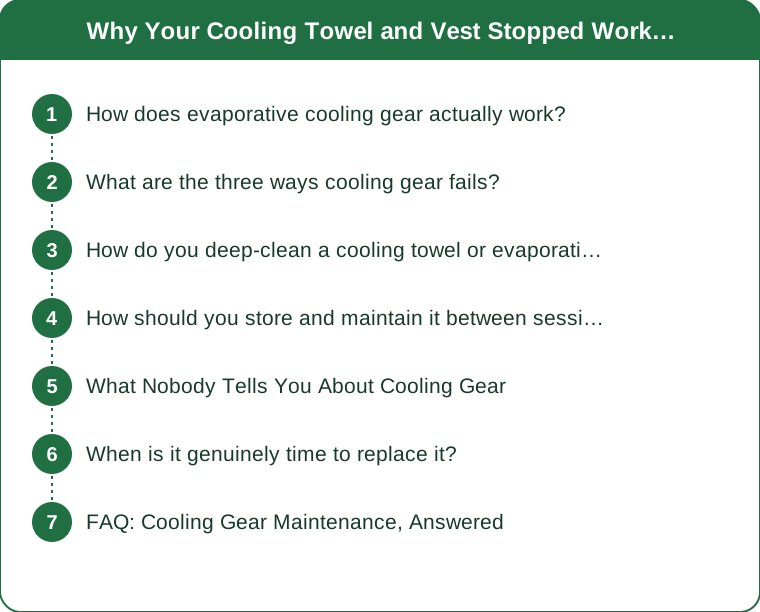
How does evaporative cooling gear actually work?
Understanding the mechanism is what makes the failures obvious, so it is worth ninety seconds.
Evaporative cooling gear works on latent heat of vaporization — the physics of water absorbing energy as it changes from liquid to vapor. When water evaporates from a surface, it pulls heat from whatever it is touching. That is why sweating cools you and why a wet shirt in a breeze feels cold.
A cooling towel is engineered to make that process more efficient than a normal wet cloth. It uses a hyper-evaporative fiber structure — typically PVA or a specialized polyester weave — with enormous internal surface area and tiny capillary channels. The design holds a large volume of water and exposes as much of it as possible to moving air, so evaporation runs faster and the cooling effect is stronger and longer-lasting than an ordinary damp towel.
Cooling vests come in two families. Evaporative vests work the same way as towels. Phase-change vests use inserts made of a material engineered to melt at a specific temperature — usually around 58 to 65°F — absorbing heat as they change state and holding a steady temperature while they do.
Which sets up the whole diagnostic framework: anything that blocks evaporation kills an evaporative product, and anything that prevents a full phase reset kills a phase-change one. Nearly every failure sits in one of those two buckets, and both have specific causes.
What are the three ways cooling gear fails?
Failure 1 — Clogging. By far the most common, and fully reversible.
The capillary structure that makes the towel work is also very good at trapping things. Over a season it accumulates sunscreen, body oil, sweat salts, hard water minerals, and — worst of all — fabric softener residue. Once those fill the channels, water no longer spreads through the fiber, and evaporation drops sharply.
The tell: the towel feels stiff when dry, water beads on the surface instead of soaking in immediately, or it takes noticeably longer to wet out than it used to.
Failure 2 — Physical degradation. Gradual and not reversible.
PVA towels become brittle with repeated dry-out cycles, especially if stored bone dry and crumpled. Fibers break, the internal surface area drops, and capacity falls permanently. This is slow, and it is usually not what has happened by mid-season.
Failure 3 — Phase-change inserts that never fully reset.
A phase-change insert has to be brought fully below its transition temperature to recharge. Put a vest back in a warm car or a 55°F fridge that never quite gets there, and it starts your next session already partly discharged. The gear is fine; the recharge was incomplete.
Diagnose before replacing. Failure 1 accounts for most complaints, and it costs nothing to fix.
How do you deep-clean a cooling towel or evaporative vest?
This restores most gear that people assume is dead. Twenty minutes of hands-on time, mostly waiting.
The soak method:
- Fill a basin with hot tap water — as hot as your tap runs, around 120°F. Not boiling; that can damage PVA.
- Add a small amount of plain dish soap. A teaspoon per gallon. Dish soap is formulated to cut oils, which is exactly the deposit you are removing. Do not use laundry detergent with added softener or scent boosters.
- Submerge and squeeze repeatedly for two to three minutes to move water through the structure, then leave it to soak for 15 to 20 minutes.
- Rinse thoroughly in cool water — several changes, squeezing each time, until no suds remain. Residual soap clogs the channels just as effectively as sunscreen did.
- For hard water buildup, add a white vinegar rinse. One part vinegar to four parts water, ten minutes, then rinse fully. This dissolves the mineral scale that soap will not touch.
How to tell it worked: hold the dry towel under running water. A restored towel wets out almost instantly and feels heavy and pliable. A still-clogged one has water running off it.
Repeat the cycle once if the improvement is partial. Two soaks recover gear that one does not.
How should you store and maintain it between sessions?
Storage causes more premature failure than use does, and the fixes are trivial.
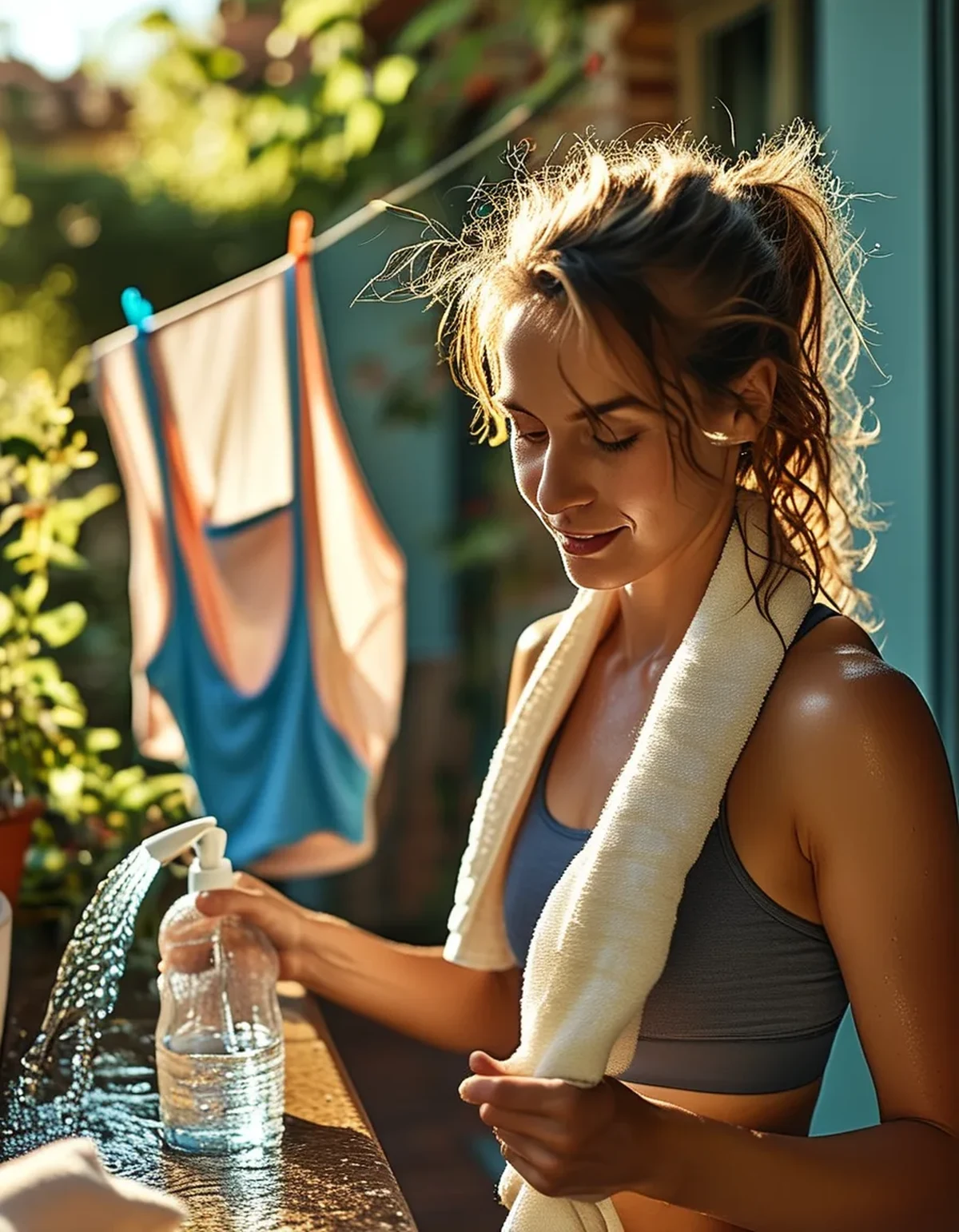
Rinse after every single use. Not with soap — just clean water, thirty seconds, squeezed through. This removes sweat salts and sunscreen before they set into the structure. Skipping this is the single biggest driver of the clogging described above.
Dry it properly, or store it damp on purpose. Two valid approaches:
- Fully air-dried, spread flat or hung. Never crumpled in a bag — crumpled drying is what makes PVA brittle and creates permanent creases where fibers break.
- Damp in its sealed case, which is how most towels are sold. This works and keeps it ready to use, but only if you rinsed it first. A damp dirty towel in a sealed tube grows mildew within days in summer heat.
Never use fabric softener, dryer sheets, or scented detergent. Softeners work by coating fibers with a thin lubricating film — precisely the opposite of what an evaporative product needs. One softener wash can noticeably reduce a towel’s performance, and it takes several soaks to remove.
Never machine dry on heat. Air dry only.
Store phase-change inserts frozen or refrigerated rather than at room temperature, so they are always ready and never sitting partly discharged.
A reasonable rhythm: rinse after every use, deep-clean monthly during heavy season, vinegar rinse if you have hard water.
What Nobody Tells You About Cooling Gear
Humidity limits it far more than heat does. Evaporative gear works by evaporation, and evaporation slows dramatically when the air is already saturated. At 90 percent humidity, a cooling towel does very little regardless of condition. If your gear “stopped working” during a humid stretch, check the dew point before you check the towel.
Sunscreen is the number one clogger, and it is unavoidable — you should be wearing it. Just rinse the towel afterward rather than trying to keep them apart.
Phase-change vests do not feel as dramatic as evaporative ones, and that is correct. Evaporative cooling feels sharper because it works on the skin surface; phase-change holds a steadier, milder temperature for longer. People often conclude the more expensive vest is worse when it is simply doing a different job.
Cooling gear works best on high blood-flow areas — neck, wrists, and inner forearms. A towel on your shoulders does considerably less than the same towel on your neck, and most people wear them in the least effective place.
Pre-cooling beats mid-session cooling for performance. Cooling before a hot effort gives you more heat capacity to spend; cooling during helps comfort more than output.
A frozen towel is not better. Ice-stiff fabric has no evaporation happening at all until it thaws, and the cold-shock feeling is not the same as cooling. Cold tap water outperforms it for actual heat removal.
When is it genuinely time to replace it?
Replace when the fiber structure itself has gone, not when performance dips.
Signs of real end-of-life:
- The towel tears or holes easily when wrung, or edges are fraying and shedding
- It stays stiff and papery even after two full deep cleans
- Permanent hard creases that do not soften when wet — broken fibers along the fold lines
- Persistent mildew smell after cleaning, which means growth inside the structure rather than on it
- For phase-change inserts: leaking, hardened lumps, or failure to fully solidify in a freezer overnight
Typical realistic lifespans, with reasonable care: a PVA towel gets one to three heavy seasons; a quality evaporative vest gets two to four; phase-change inserts often last five-plus years since the material itself does not wear out, though the carrier vest fails sooner.
What is not a reason to replace: reduced performance in humidity, discoloration or staining, a towel that has gone slightly grey, or one bad session. Deep-clean first, test in dry conditions, and judge then.
One genuine safety note: cooling gear is a comfort and performance aid, not protection from heat illness. If you are experiencing dizziness, confusion, nausea, headache, or you have stopped sweating in the heat, stop and get out of it immediately — a cooling vest does not make it safe to continue. This is general information, not medical advice.
FAQ: Cooling Gear Maintenance, Answered
Can I put a cooling towel in the washing machine?
Most tolerate a gentle cold cycle with plain detergent, but hand soaking is more effective because you can work water through the structure by squeezing. If you do machine wash, no softener, no bleach, no dryer, and use a mesh bag to prevent snagging.
Why does my towel smell even after washing?
Usually mildew inside the fiber structure from being stored damp and unrinsed. A vinegar soak — one part vinegar to four parts water for 30 minutes — clears most of it. If the smell survives two treatments, growth is established in the structure and it is time to replace.
Do cooling towels expire if unused?
Not on a shelf, dry and flat, but PVA gets brittle over years regardless of use. A towel that has sat crumpled in a hot garage for three summers is likely degraded before its first use.
Is a cooling vest worth it over a towel?
For sustained outdoor work or exercise in heat, yes — much larger surface area and longer duration. For short sessions or intermittent use, a towel delivers most of the practical benefit at a fraction of the cost. Start with the towel and upgrade only if you are regularly out in heat for over an hour.
TL;DR: Cooling gear usually clogs rather than wears out, and clogging is reversible.
- Sunscreen, body oil, salt, and hard water fill the capillary structure that evaporation depends on.
- Deep-clean with a hot water and dish soap soak, 15 to 20 minutes, then rinse thoroughly. Add a vinegar rinse for hard water.
- Never use fabric softener or dryer sheets — the coating they leave is exactly what kills evaporative fabric.
- Rinse after every use, air dry flat or store damp in a sealed case only if it was rinsed first.
- Phase-change inserts need a full reset below their transition temperature; a warm fridge leaves them half-charged.
- Wear it on the neck and wrists, not the shoulders, and pre-cool rather than only cooling mid-session.
- Replace only for torn, shedding, permanently stiff, or persistently smelly gear — not for a bad humid day.
Try two deep cleans before you buy anything. Most “dead” cooling gear is just full of sunscreen.
See It in Motion
Seen here: High Waist Yoga Leggings with Inner Pocket — shop it on bubblelime.com
Keep Reading
This article is for general informational and styling purposes only. Fit, sizing, and product availability may vary.