Do Cooling Arm Sleeves Actually Work, or Is It Just a Placebo?
Quick Answer: Cooling arm sleeves work through evaporative cooling and UV blocking rather than actively lowering skin temperature much — they help most in dry heat and direct sun, less in humidity.
They’ve become a familiar sight on summer runs and golf courses, but it’s worth understanding what they’re actually doing before you decide if they’re worth the drawer space.

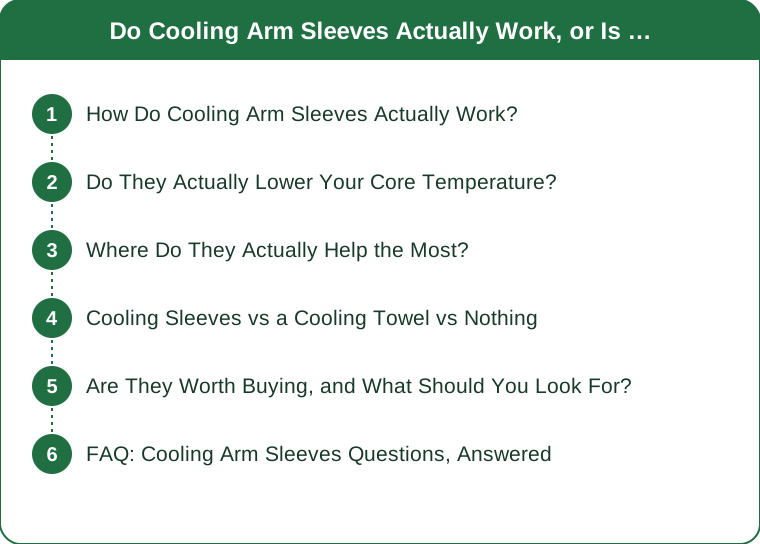
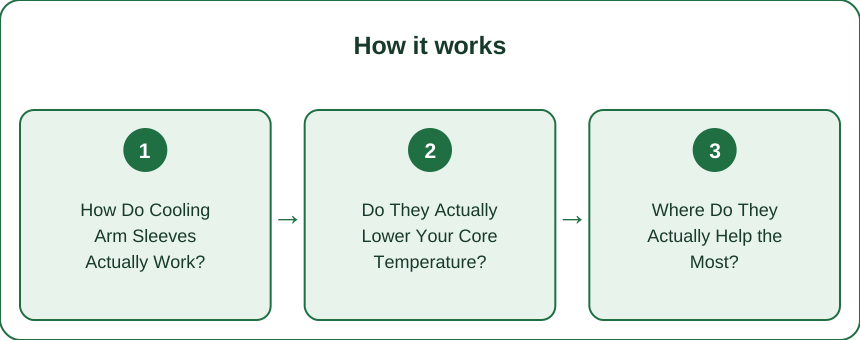
How Do Cooling Arm Sleeves Actually Work?
Most cooling sleeves use one of two mechanisms: a moisture-activated fabric that you soak in water before wearing, which cools through evaporation as you move, or a UPF-rated fabric that simply blocks direct sun exposure to keep skin from heating up in the first place.
The soaked kind can feel noticeably cooler for the first 20-30 minutes, then gradually warms as the water evaporates — expect to re-wet them on anything longer than 45 minutes in serious heat.
Do They Actually Lower Your Core Temperature?
Not by much. Research on localized cooling garments generally shows they affect perceived exertion and skin comfort more than they move your actual core body temperature, which is regulated by your whole circulatory system, not one limb. A 2016 study on peripheral cooling found meaningful perceived-exertion benefits without significant core temperature change.
That’s still useful — feeling cooler can let you push harder or longer before you hit your discomfort limit — but don’t expect them to prevent heat exhaustion on their own.
Where Do They Actually Help the Most?
Dry heat is where evaporative cooling sleeves shine — low humidity means faster evaporation and a stronger cooling effect. In humid climates, evaporation slows dramatically and the sleeves do less; you’re mostly getting the sun-blocking benefit at that point.
They’re also genuinely useful for anyone dealing with sun sensitivity from medication, or fair skin that burns fast — the UPF protection alone can be worth wearing them for.
Cooling Sleeves vs a Cooling Towel vs Nothing
A cooling towel around your neck typically outperforms sleeves for perceived cooling, because the neck has a high concentration of blood vessels close to the skin — cooling there affects how warm your blood feels faster than cooling a forearm does. Sleeves are more convenient for activities where a towel would flap or get in the way, like cycling or golf.
Going bare-armed in dry heat with a light long-sleeve is sometimes just as effective for sun protection, minus the cooling boost — it comes down to what you’ll actually wear consistently.
Are They Worth Buying, and What Should You Look For?
At $10-20 for a pair, the cost of entry is low enough that trying them isn’t a big risk. Look for ones with a stated UPF rating (UPF 50 is standard for good sun protection) and a fabric blend that mentions cooling-activation-on-wetting, not just ‘moisture-wicking,’ which is a different (and weaker) property.
Avoid anything that feels stiff when dry — that usually means less airflow and a worse cooling response once wet.
FAQ: Cooling Arm Sleeves Questions, Answered
Can I wear cooling sleeves for weightlifting instead of running?
Yes, though the cooling effect matters less indoors with AC — most people wearing them for lifting are after the compression feel or sun protection during outdoor training, not the cooling.
Do cooling sleeves work without wetting them first?
Some UPF-only sleeves are designed to be worn dry and rely purely on sun-blocking, not evaporation — check the product description, since the two types perform very differently.
How often do I need to re-wet them during a long session?
Expect to re-wet every 30-45 minutes in hot, dry conditions — carry a small water bottle specifically for this if you’re out for over an hour.
TL;DR:
- They cool through evaporation and sun-blocking, not by lowering core temperature much
- Dry heat is where they work best; humidity blunts the effect significantly
- A cooling towel on your neck often out-performs sleeves for perceived cooling
- Low cost makes them worth trying if you train outdoors in summer sun
They’re a modest, genuinely helpful tool for dry-heat training — just keep your expectations calibrated to what they can actually do.
See It in Motion
Seen here: High Waist Jogger Sweatpants with Pockets — shop it on bubblelime.com
Keep Reading
This article is for general informational and styling purposes only. Fit, sizing, and product availability may vary.